

VOX AC100 - UPDATES AND NEW INFO
20223
30th December
Fun with companies. In relation to the first entry yesterday - "Relda" is "Adler" backwards and "Adler" is "Eagle" in German.
29th December (2)
To add to the entry below, the transistor megaphone - model ER305 - in the JMI list was actually manufactured by the TOA Corporation of Japan (and doubtless imported to the UK by Eagle Products). An example can be seen in the picture of Dick Denney at the Vox stand, "Association of Public Address Engineers" show, March 1965.

A detail of the pic of Dick Denney at the APAE show, March 1965. The whole can be been below, entry for 20th December.
A TOA ER-307 to give some sense of the colour:


29th December
In the 1970s "Eagle International" was a big name in the world of budget hifi, its amplifiers and tuners stocked by Lasky's, Comet Warehouses, and many others. Most who were schoolboys in Britain during that decade will have had an "Eagle International" something or other.
The company began life in the late 1950s as "Eagle Products", based on Coptic Street, just down from the British Museum, and traded under several other names: "Relda Radio", and "B. Adler and Sons (Radio) Limited", the latter being the controlling entity.
By the early 1960s, a sizeable proportion of Eagle's catalogue comprised of imports from the Far East, particularly from Sacom Electronics in Japan. Eagle evidently made secondary distribution arrangements too. The items listed in the JMI pricelist below, posted earlier this year (12th September), are actually Japanese-made "Eagle Products" gizmos. Tom as ever was keen to diversify. Whether JMI added its own badge (as it had some years earlier to Italian-made Meazzi echo units) is unknown.
In view of what is said about the Japanese origins of the circuit employed in the JMI microphone mixer - see this page - it seems highly likely that the model copied by the Jennings engineers was a unit made by Sacom.
It may be, now that names are known, examples (or at least illustrations) of the items listed can be identified.

Pricelist 1964. IThe suggestion made earlier this year that the items listed were made by Westrex, which entered the field of portable transistorised PA units early on, must be put to one side.

Detail from an "Eagle Products" advert, November 1964 - the CA512.
23rd December
Some notes on the Vox MC30/4 Public Address amplifier, introduced in early 1964, 30 watts power, four ECC83s in the preamp, solid state rectification and either four EL84s or two EL34s, though these last must have been run at low level (as in the case of early single-speaker AC/30s).
Early units were slope-fronted, measuring 14" x 14" x 7 1/8", much as the MC50 and MC100, but weighing 35lbs. The MC50 and MC100 weighed 40lbs and 43lbs respectively.
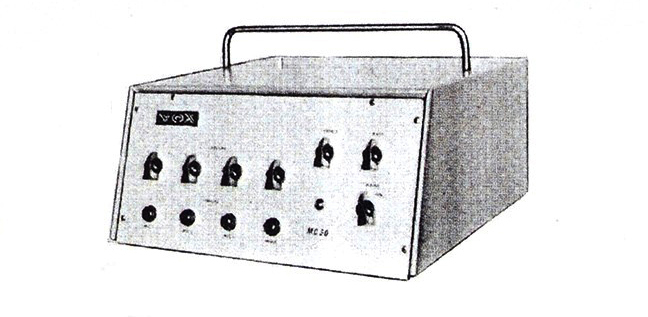
The MC30 as illustrated in the Vox Public Address brochure of early 1965. It is unlikely that production models had the legend underneath the mains indicator lamp.
In mid 1965, the Metal Clad range was redesigned. Enclosures became flat fronted, measuring - in the case of the MC50 and MC100 (and presumably the MC30 too) - 14" x 17" x 7 1/2". Finish was grey hammerite.
In late 1965, preamp assemblies were produced with blue/grey fronts and legends in white. Although no corroborating example has so far come to light, it seems likely that MC30s were also produced in this form in 1966.
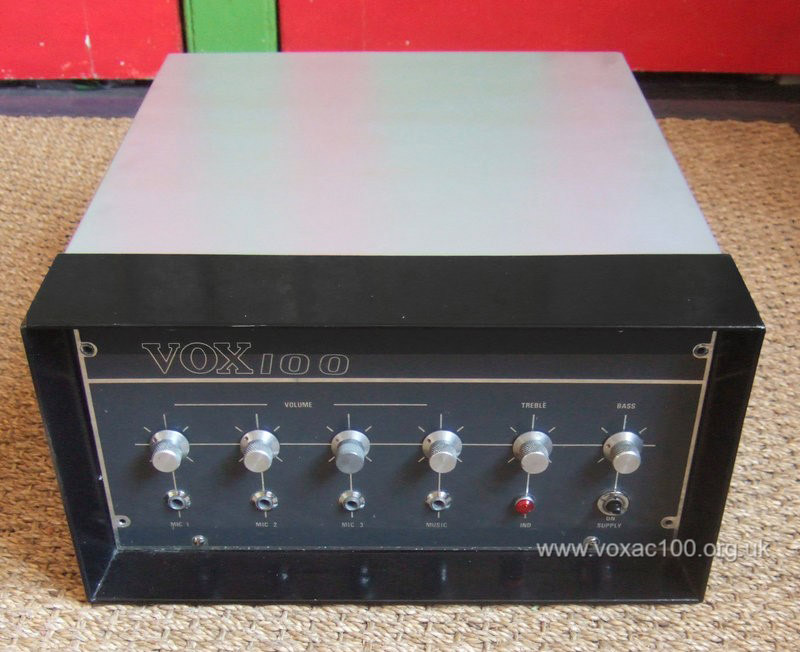
A Vox MC100 from late 1965 / early 1966, measuring 14" x 17" x 7 1/2".
Below, a number of references to Vox PA 30 watt amplifiers in the small ad sections in "Melody Maker" magazine, 1966 and 1967. Pan Music (the first three items) regularly sold discounted and surplus JMI stock, an arrangement going back to early 1965.
Quite how it was known that the AC30 amplifier sections in the first advert were "P.A.tops" is not known. Possibly the speaker cables for the LS40 columns were hard-wired, or at least still present. A good number of AC30 Super Twin amps were indeed supplied from factory with Public Address column speakers.
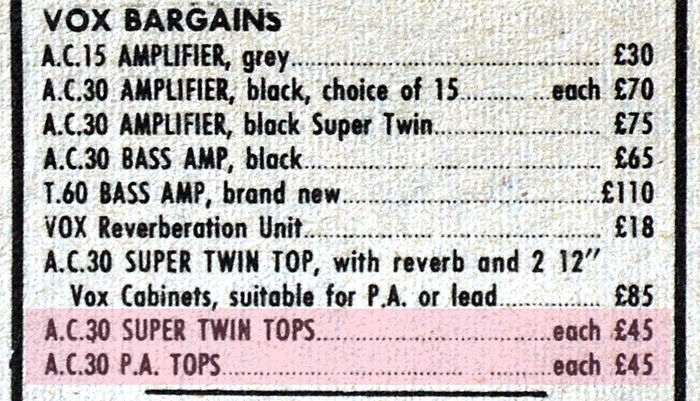
28th February 1966.
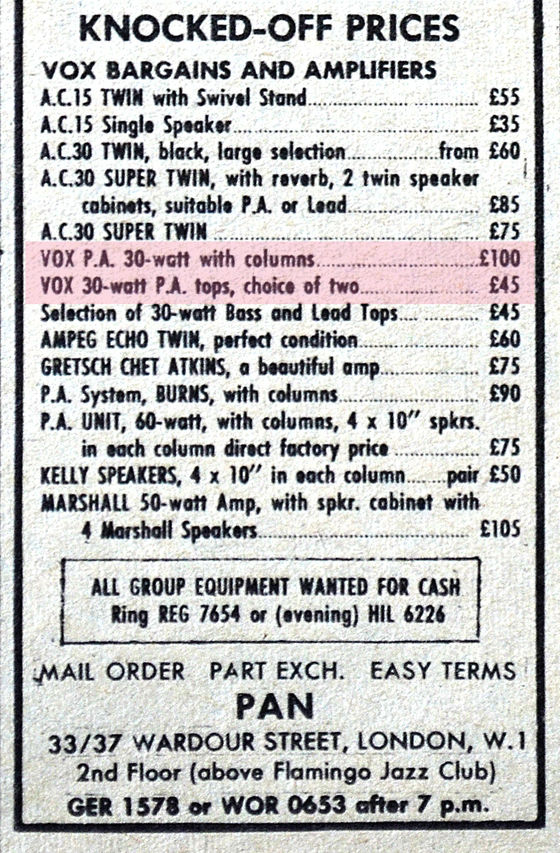
12th March 1966.
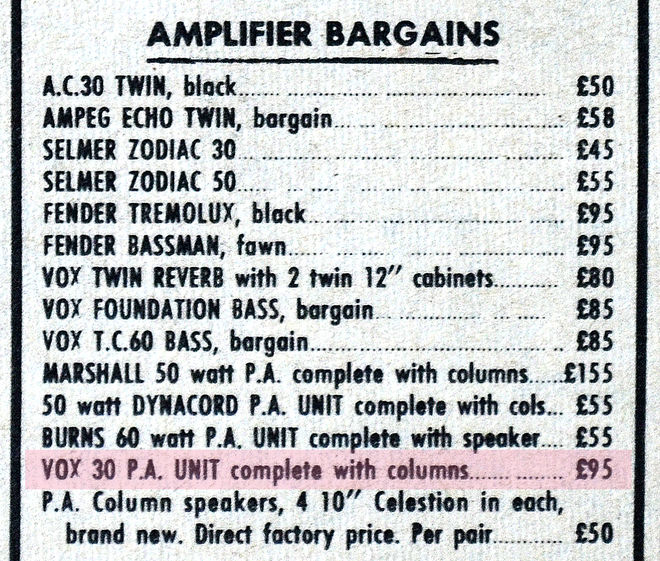
7th May 1966.
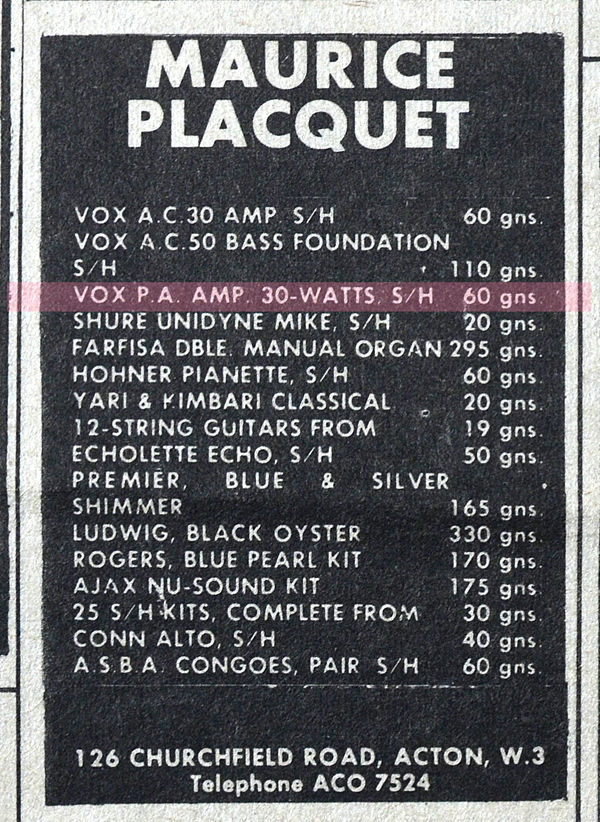
14th January 1967. Possibly an old slope-fronted model.
20th December
Also posted on the Vox AC30 website. Pictures that have come to light recently indicate that the well-known photo of Dick Denney at a Trade Show - below - was not taken at the Russell Hotel Fair of August 1964, but at the exhibition arranged by the "Association of Public Address Engineers" in March 1965. Jennings had been a member of the Association since late 1963 - further details on this page (1964) and here (1965).

Dick Denney at the Jennings stand, "Association of Public Address Engineers", Harrow, March 1965. A cropped version of this picture was published by Jim Elyea.
At left, in the corridor, one can see "Fi-C". This is Fi-Cord, makers of and agents for high-quality tape recorders. Fi-Cord did not manufacture musical instruments and so did not exhibit at the "British Musical Instrument Industries" shows at the Russell Hotel.
Below, a detail from the schematised floor plan of the stands, Harrow, March 1965. Jennings had 62-65, Fi-Cord were in 60 and 61. Doors/openings are not rendered accurately.
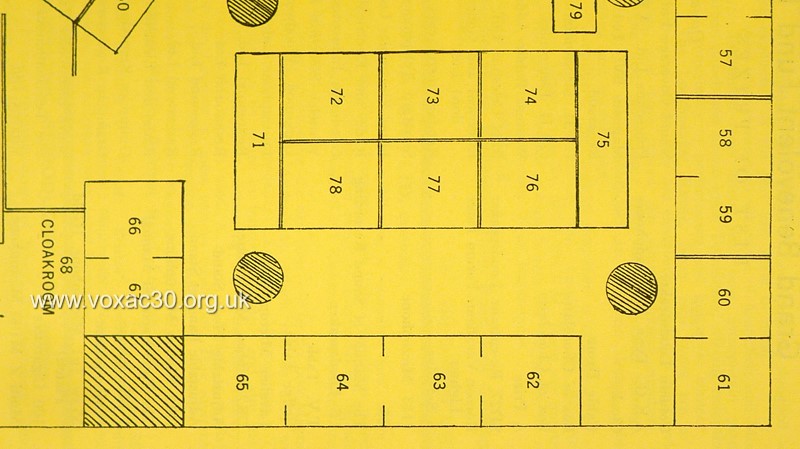
Floor plan of the stands, Harrow, March 1965.
A different shot from the Public Address exhibition of March '65 was printed in "The Vox Story", Denney and Petersen, 1993. The same perspex AC30 and circular plinth were also displayed at the Russell Hotel Fair in August 1964 (present in the pictures recently emerged) and at the Frankfurt Musikmesse in February '65.

A slightly different angle, Harrow, March 1965.
The AC30 centre right in the picture above is probably an Expanded Frequency model (2x15" speakers).
18th December
Old pictures of a Jennings J68 double manual organ, made for only a short time in 1969, probably having been announced (though not displayed) at the Russell Hotel Trade Fair in August 1968. On Jennings in 1969, see this page.
At least one other J68 is known to exist (currently in the UK).


Jennings J68 double manual organ.
24th November
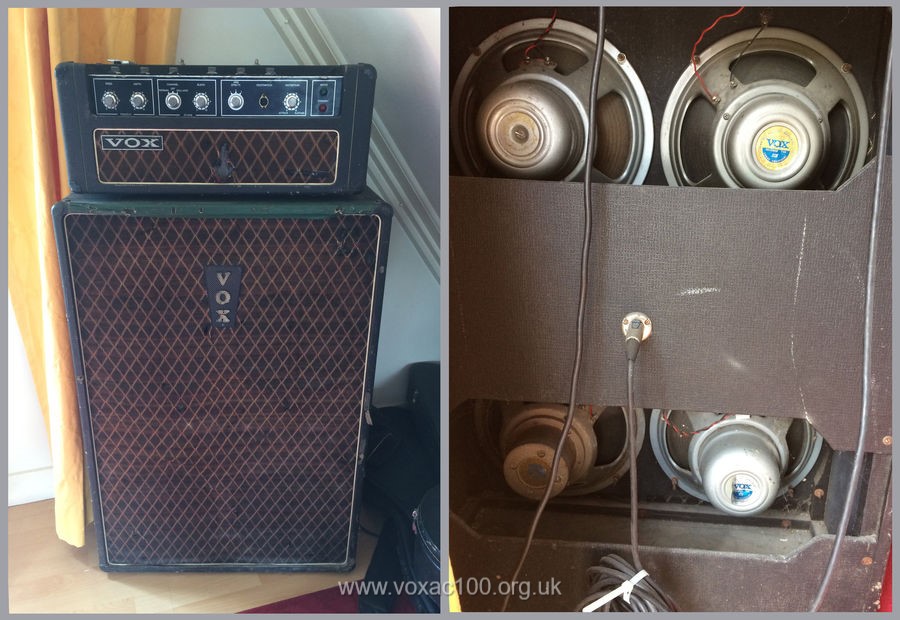
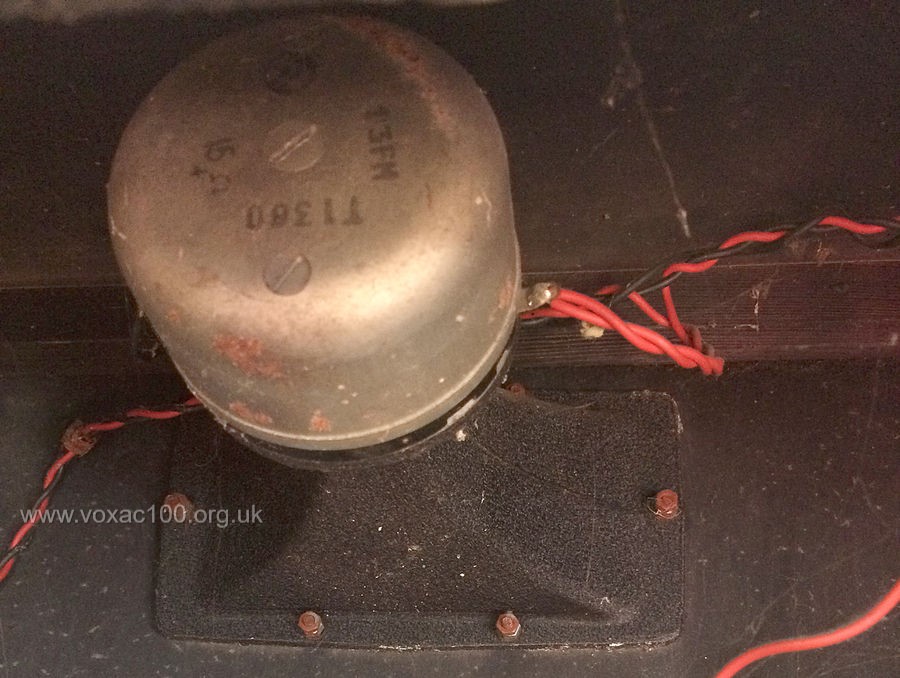
Thanks to Tim, pictures of an AC100 SDL speaker cabinet from the second half of 1967 (a Vox Defiant amplifier section on top). Two of the original Celestion T1088s remain along with at least one of the original Celestion T1360 horns, date code 13FM = June 1967. Celestion T1360s with June '67 date codes were also for a short time in Vox Supreme speaker cabinets.
18th November
A brief overview of the 12" speakers used in Line Source 60 Public Address columns, introduced at the Russell Hotel Trade Fair, August 1965. The columns, normally issued in pairs, were designed to accompany the MC150 public address amplifier (150 watts), the handling power requirement for each being 80 watts at least (4 x 20 watts):
1) A 12" unit with a twin cone, one cone described as being a "tweeter" in reviews of the Fair. The speakers are likely to have been Fane 122/10a - see the information sheet at the foot of this entry.
2) Early and mid 1966. Fane 122/10 - the single cone version of the above. 20 watts, 15 ohms.
3) Later 1966 and 1967. Celestion T1252 sprayed poly grey. Lightweight magnet, 20 watts, 15 ohms.
4) Later 1966 and 1967. Perhaps only a very few. Celestion T1225. Heavyweight magnet, 25-30 watts, 15 ohms.
5) Late 1967 through to the end of 1969. Goodmans, probably 214/1214/15, heavy frame and magnet, 25-30 watts, 15 ohms. Or, very similar in general appearance, the 112/1214/15, lighter frame and magnet.
6) 1970 to 1973. Celestion T1252 Greenback. Same specifications as (3) above.
The list above should not be regarded as being exhaustive at present. Also to say, there was evidently some chopping and changing within the periods in view. A pair of "Vox Sound Equipment Limited" cabinets has Fanes for instance; and a later "Vox Sound Limited" set each has two Goodmans 241s and two Celestion T1252 Greenbacks. It may be possible to chart the occasional changes in more detail in future updates.
The page on LS60 columns will be updated shortly.

Detail from the Fane catalogue of late 1965.
14th November
Just to note that a page on the Celestion speakers used by Vox, 1967 to 1973, has been started on the Vox Supreme website.
Relevant sections will be linked up with the speaker cabinets illustrated and discussed on pages here.
13th November
Below, two 10" wall speakers, one with a Celestion 7721, the other with an Elac ON/86, both 15 ohms. Given the different styles of logo and back panel, possibly not sold together as a pair.
The cabinets for 10" speakers measure 12 1/2" x 12 1/2" x 6 1/4". The cabinets for 14" speakers are 14" x 14". Due to their sloping fronts, depths at top and bottom are different: 6 7/8" at top, 7 5/8" at bottom.
From 1966 to 1968, the wooden cases are likely to have been produced for Jennings under contract by Heslop and Company Limited, a fellow member of the Royston Group. From late 1968 to late 1969, the contractor for "Vox Sound Equipment Limited" is likely to have been Heathpoint Timber.
12th November
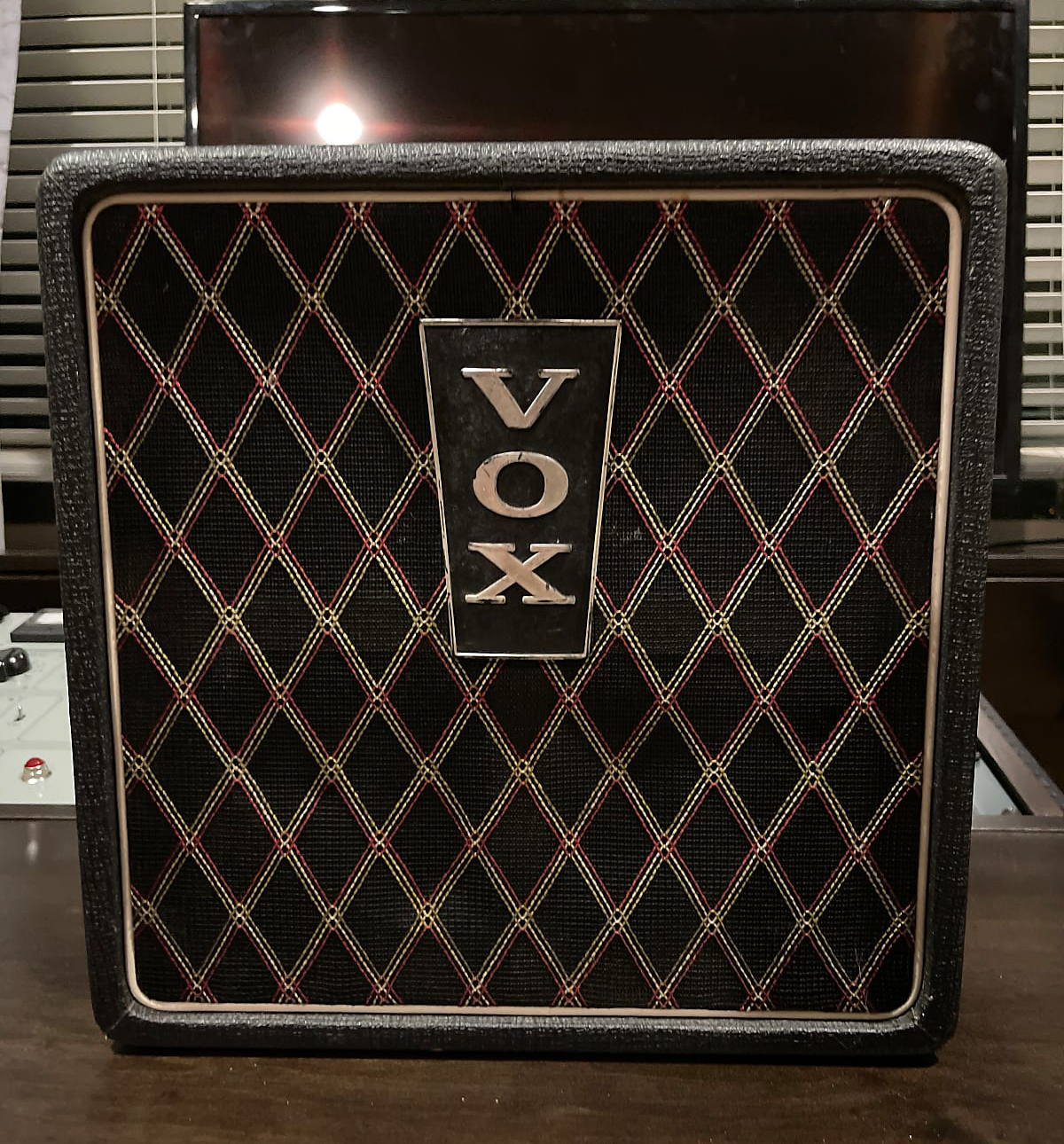
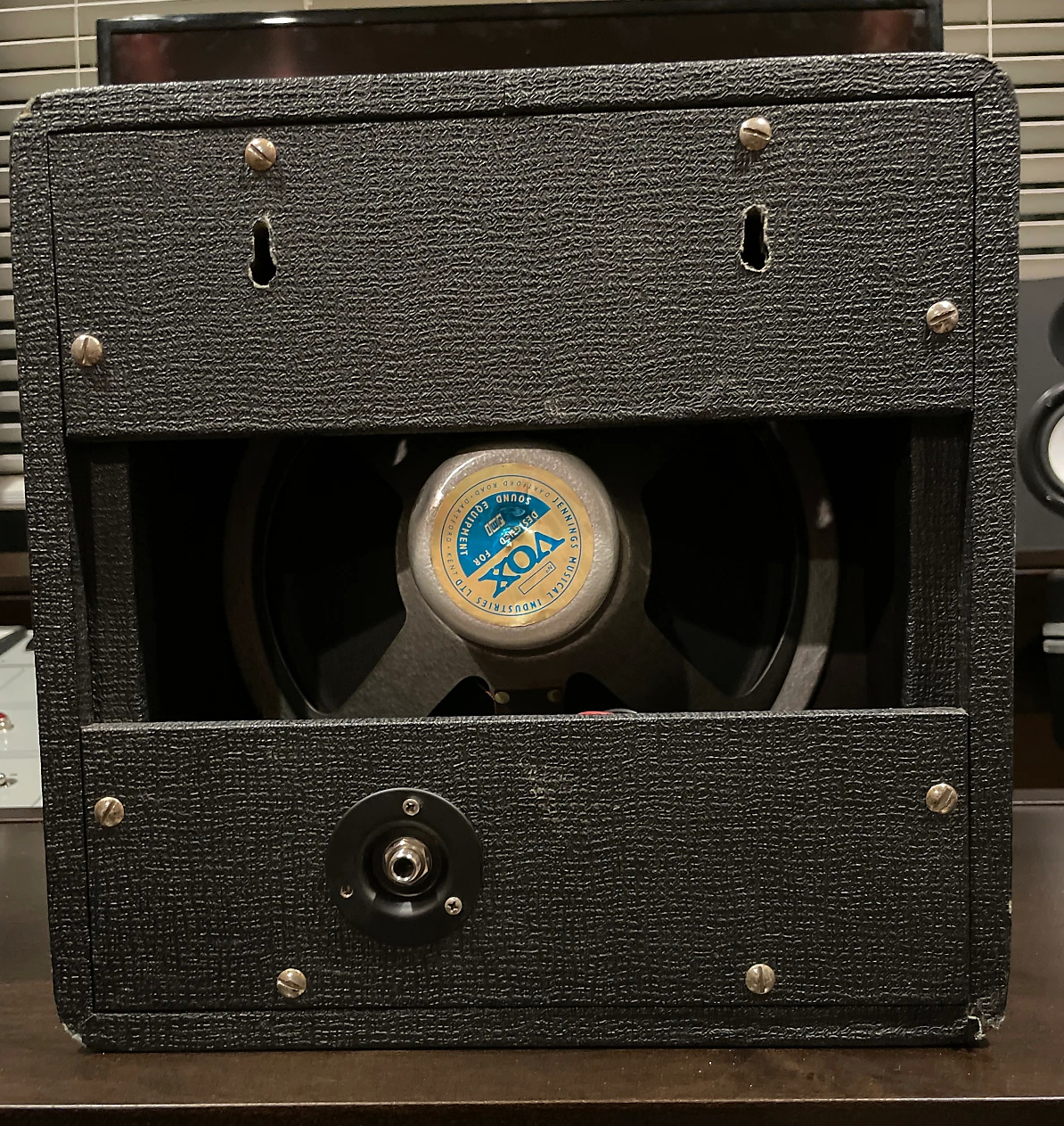
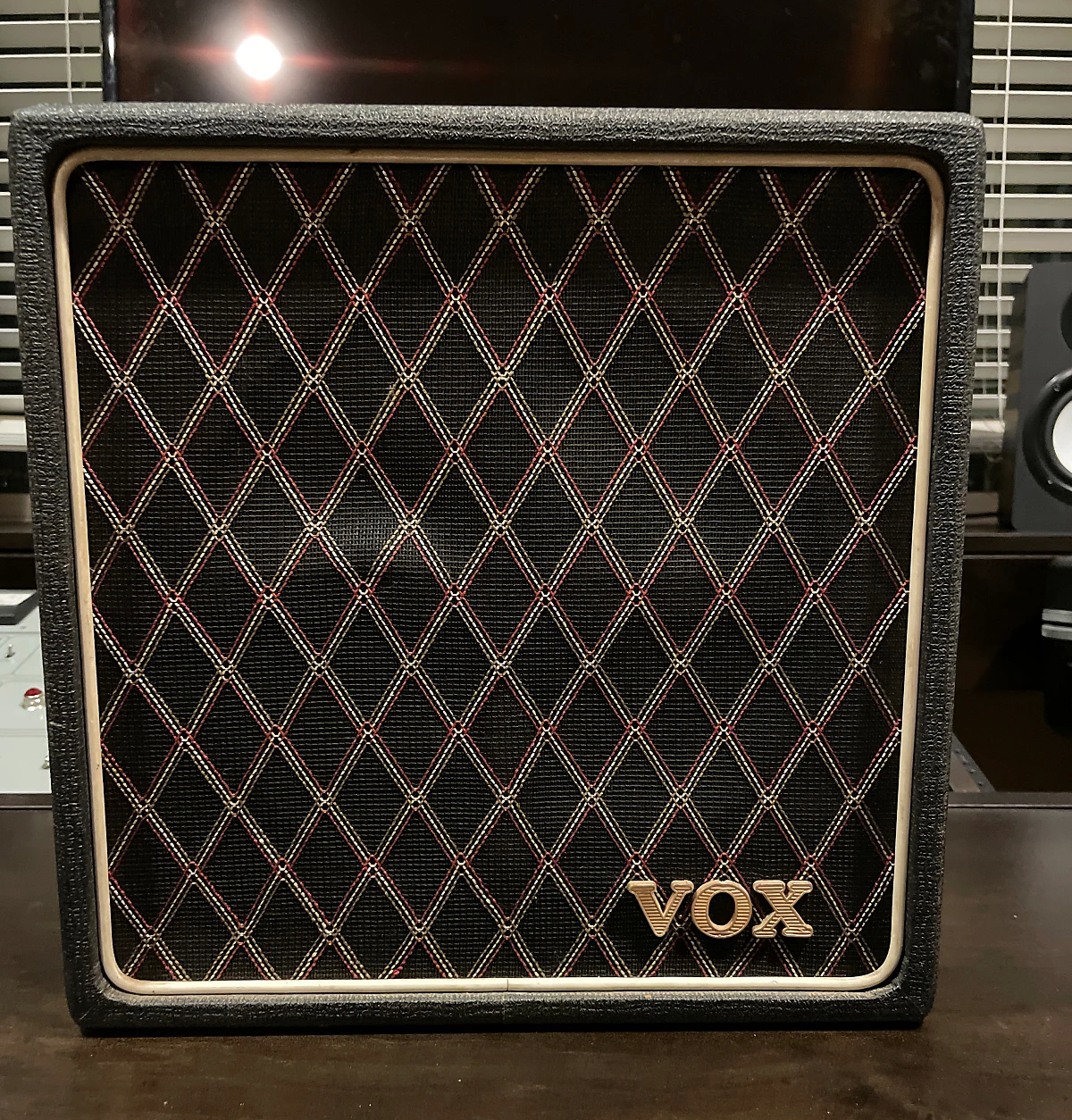
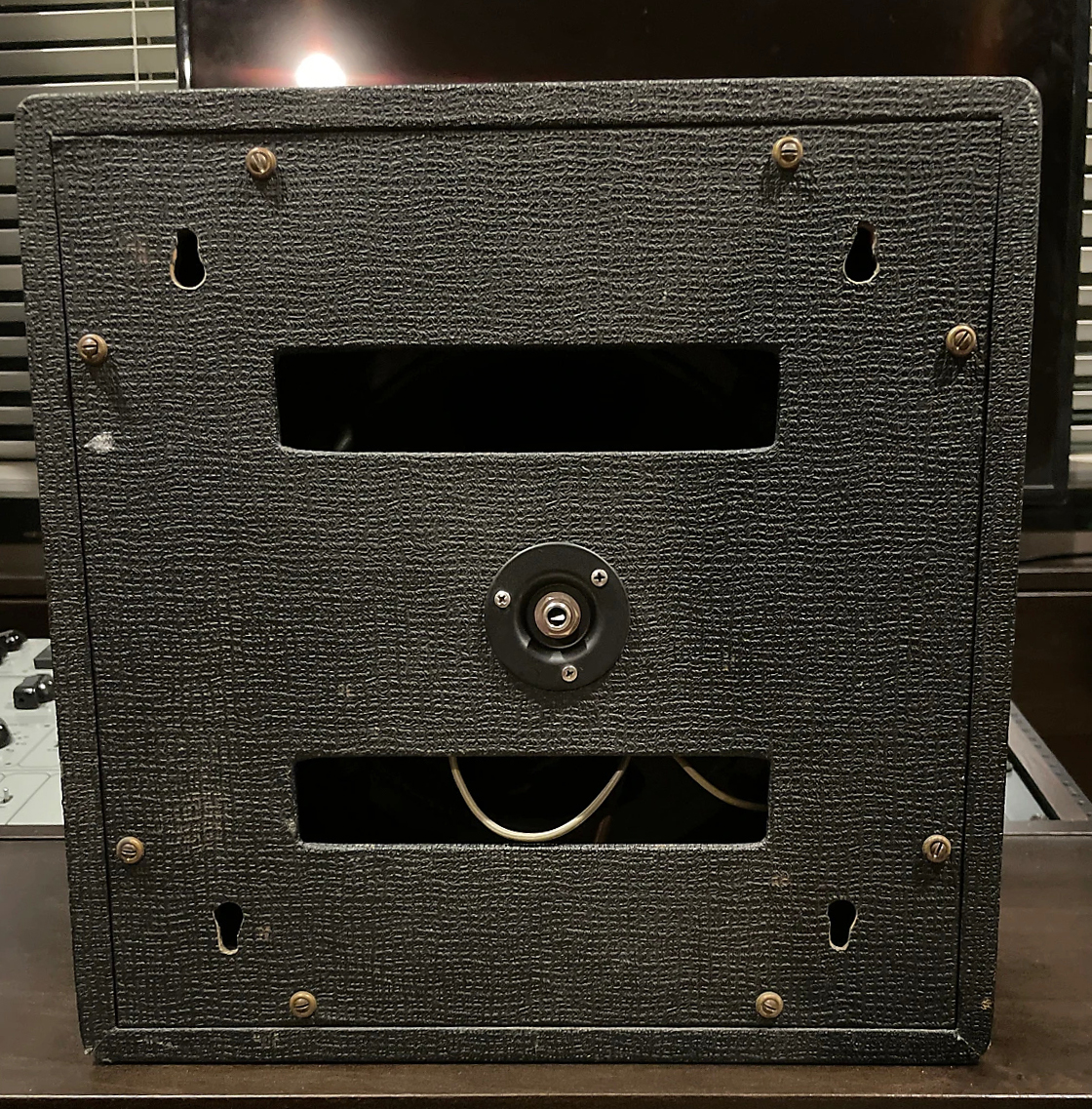
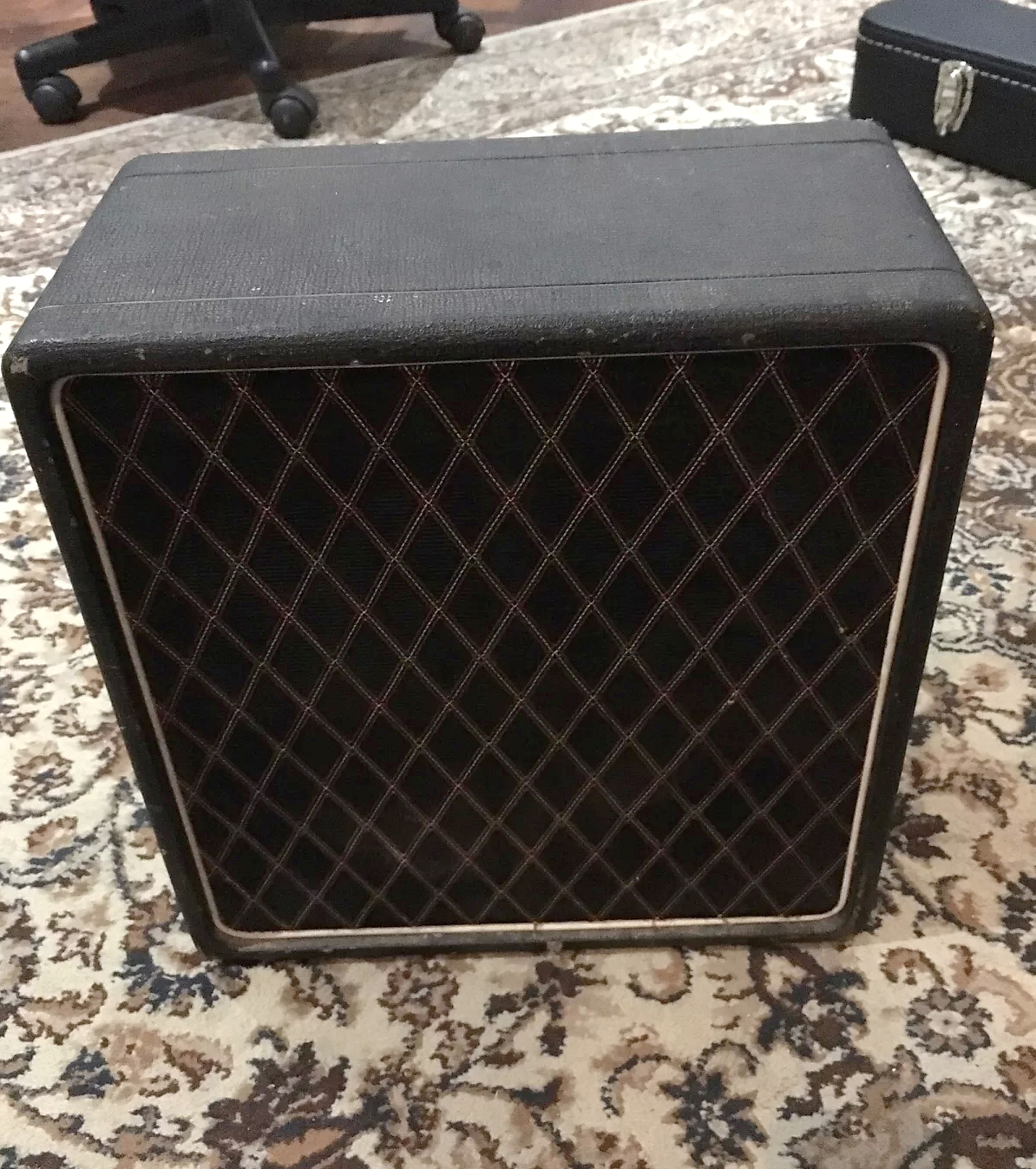
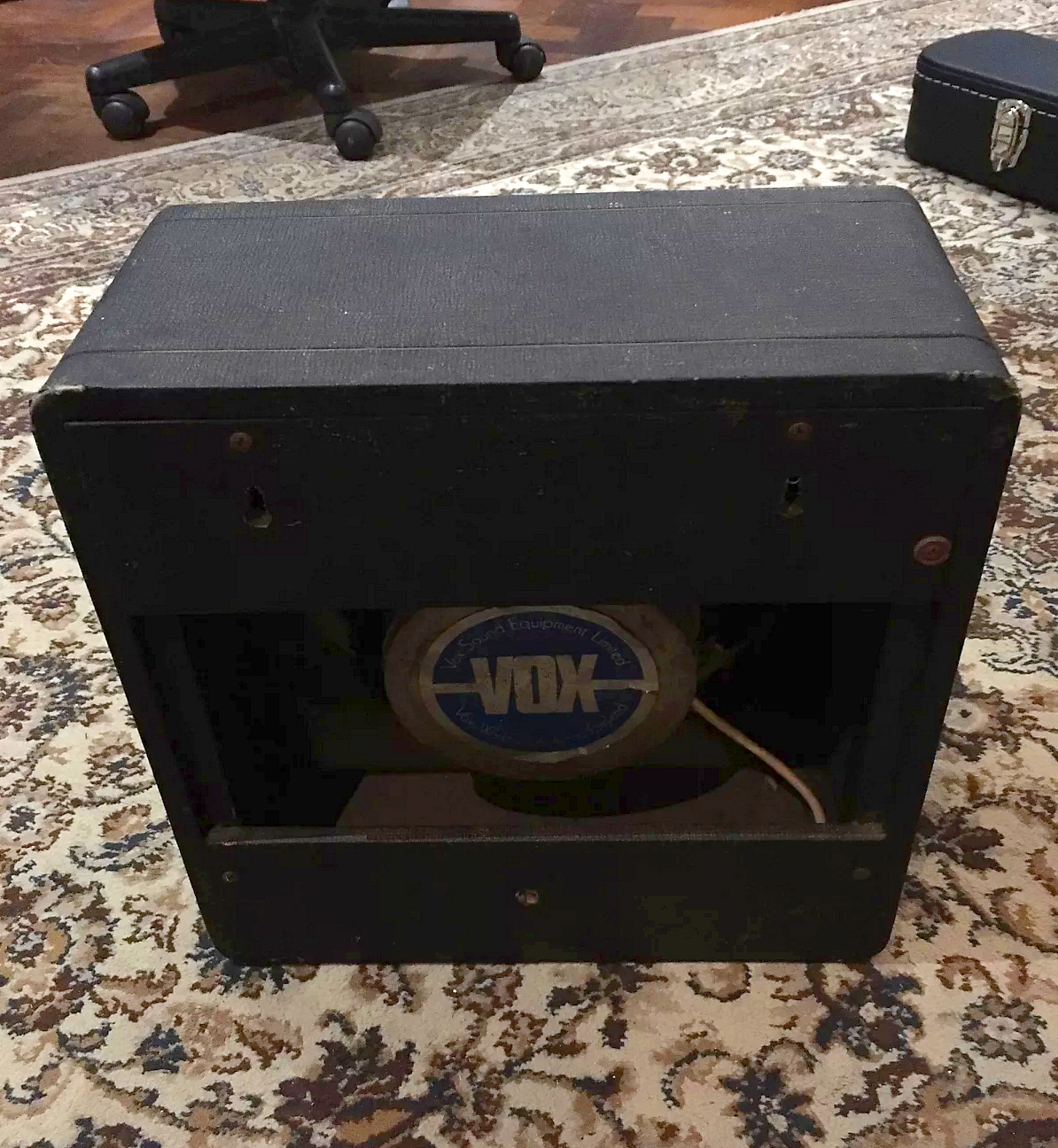
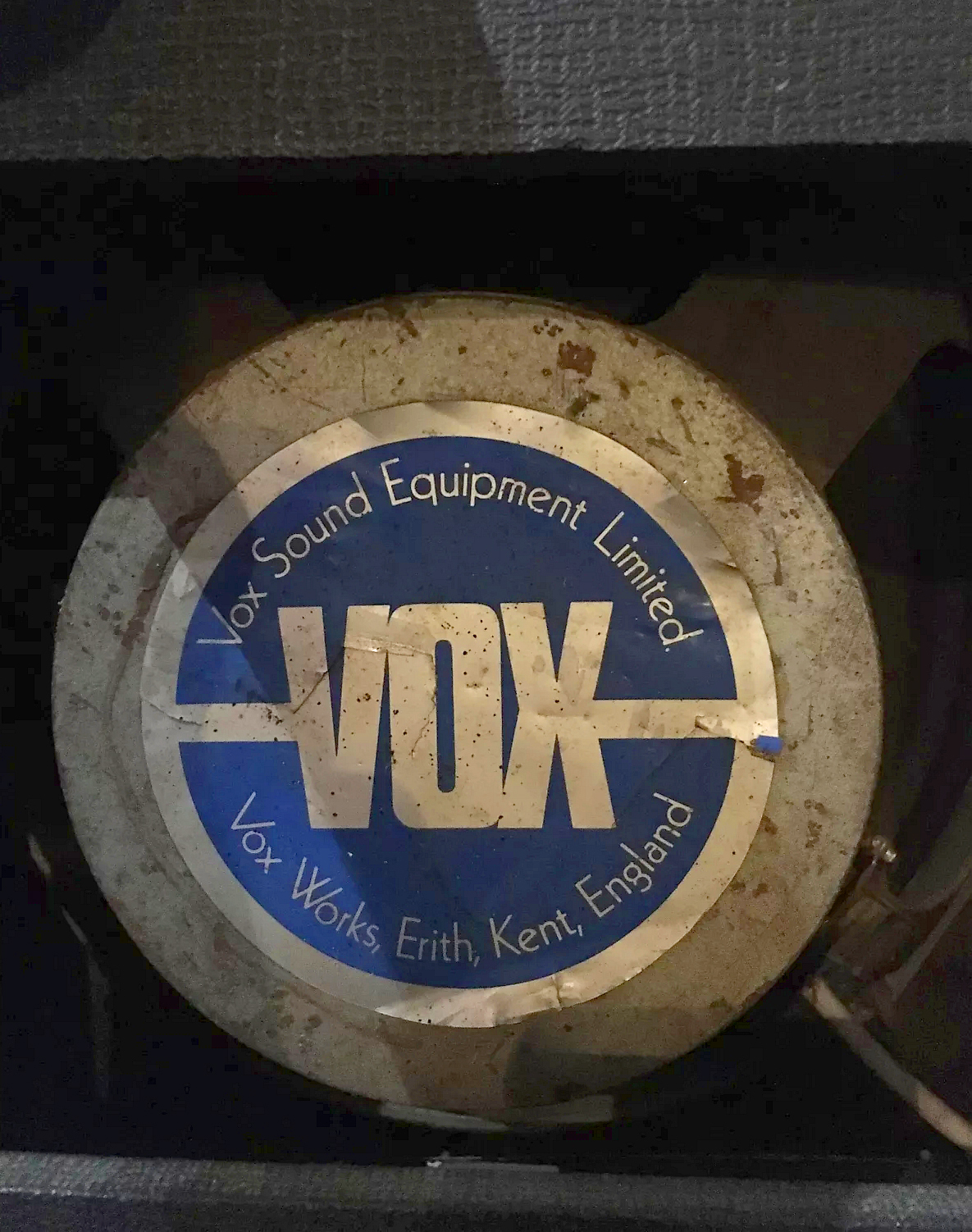
A cabinet - for wall mounting - containing a 12" Fane 122/17 speaker with a "Vox Sound Equipment Limited" label. VSEL ran from the summer of 1968 to late 1969. In the pricelist issued in early to mid 1969, such units were £21.0.0 each. Cabinets containing single 8" and 10" drivers were also available (as they had been in JMI's time). All three types - 8", 10" and 12" - remained in VSEL's catalogue through to the end of business in December '69.
For an overview of these cabinets, see this page.
11th November
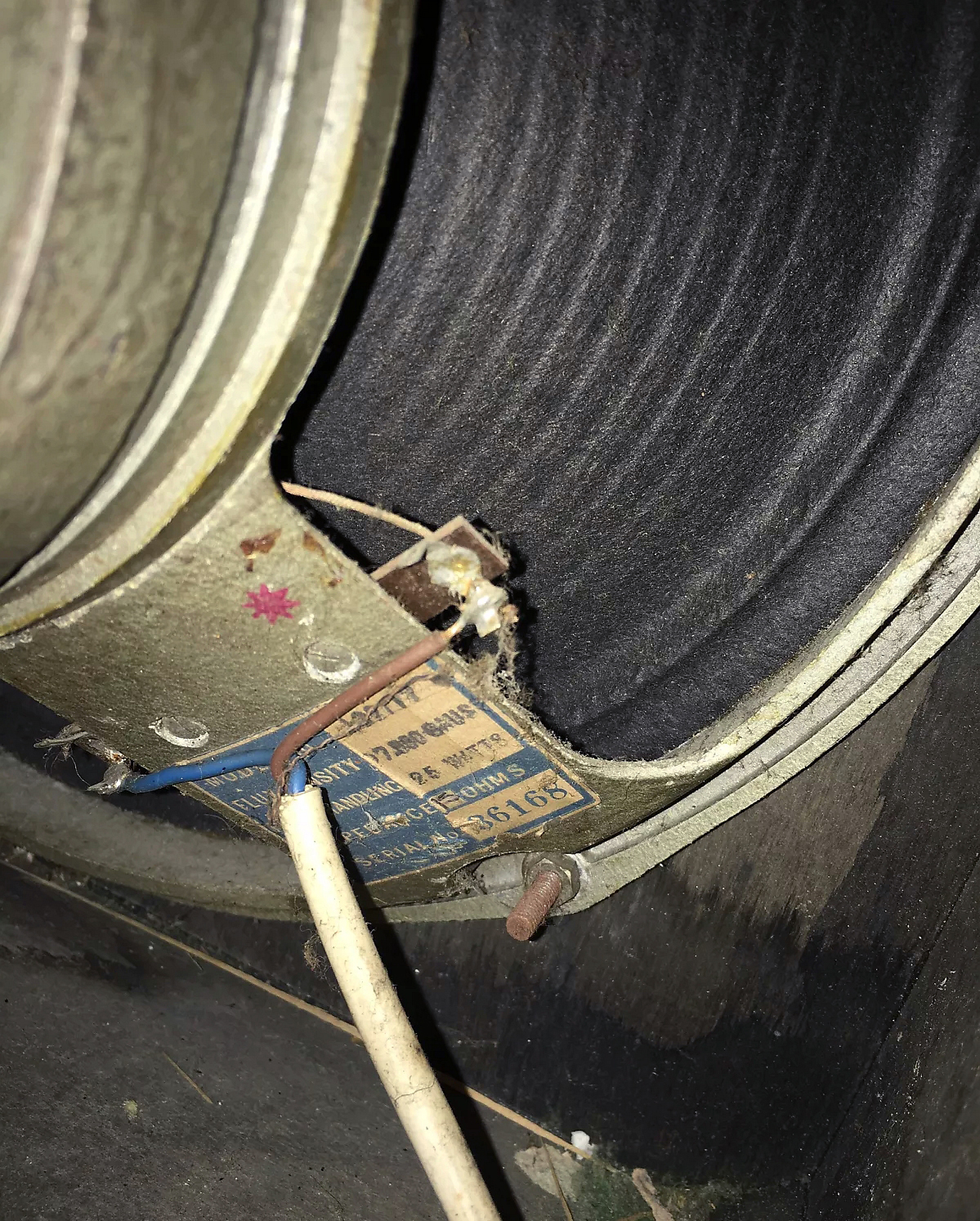
Thanks to Mark, pictures of the chassis of an amp with a serial number probably in the 1500s.


Chassis number 1823. In the preamp, the principal filter caps are two green TCC and one blue Hunts, the cathode bypass are blue Hunts. Output transformer and most of the power section components removed.
10th November
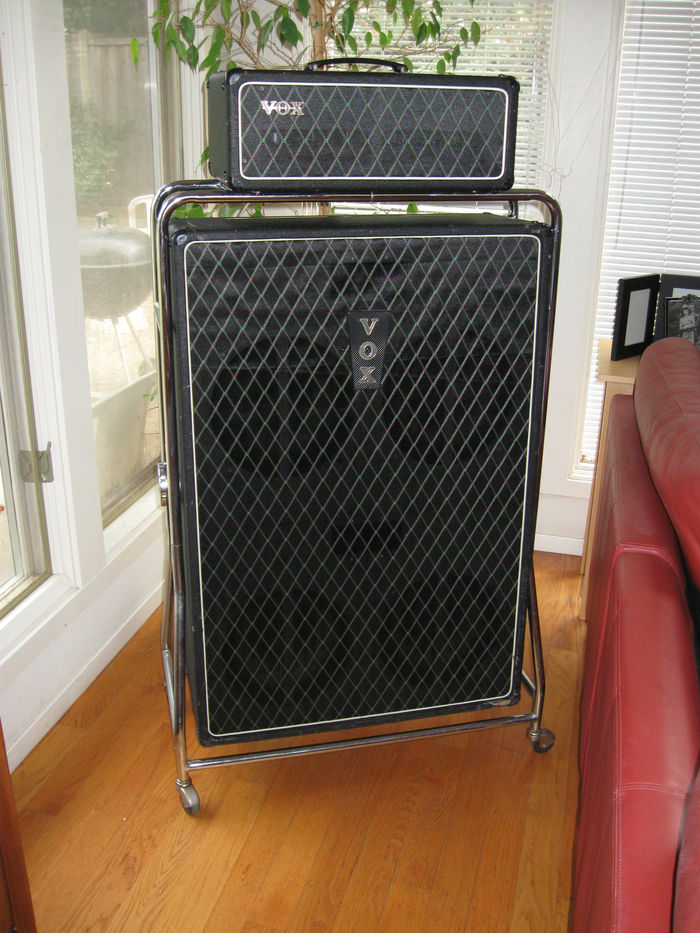
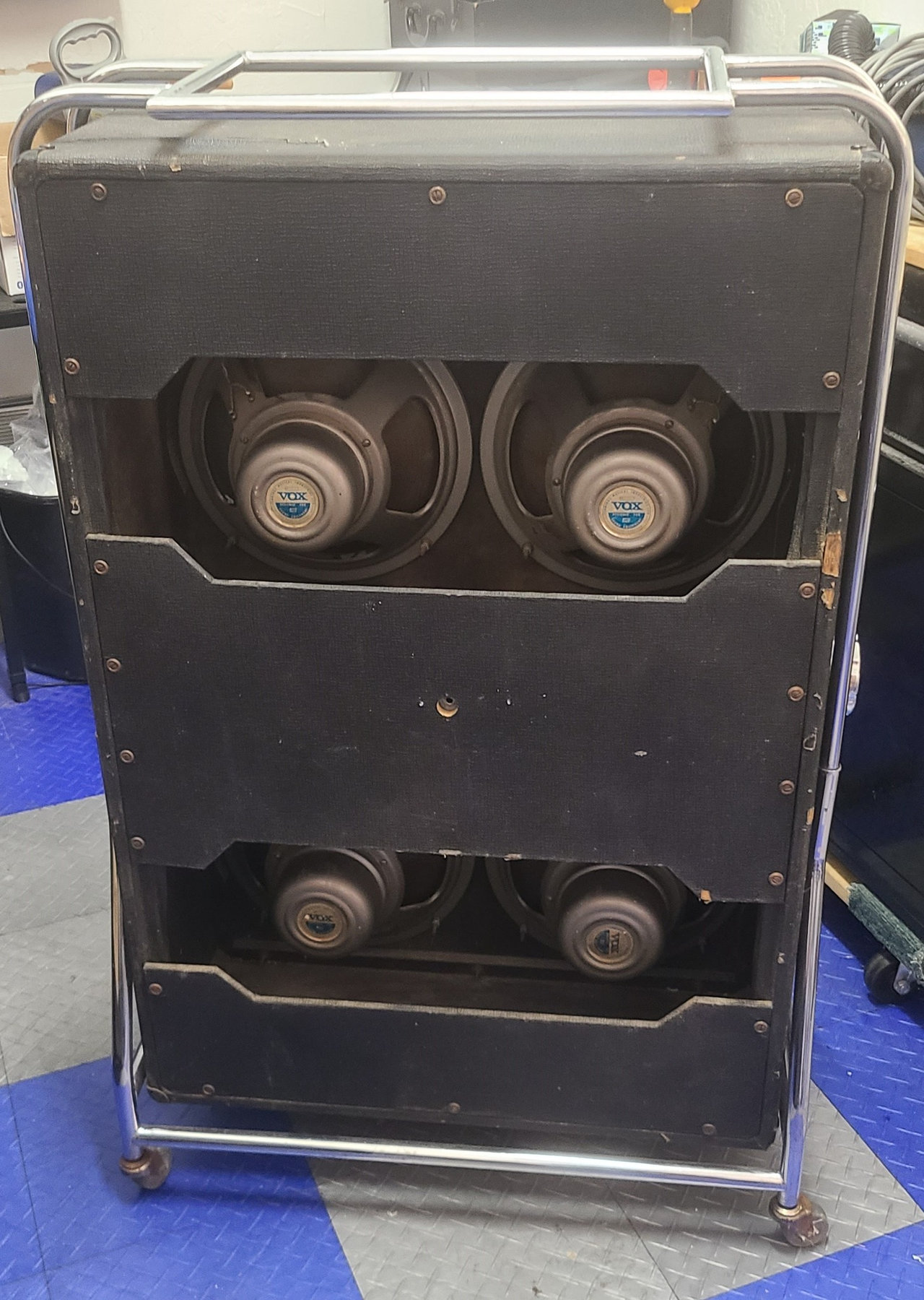
Thanks to Glenn, a great pic. The amplifier section was imported to the USA from England in the 2000s, and the cabinet - an AC100 cab - found locally. The trolley is from a Thomas Organ solid state Super Beatle.
25th October
Thanks to Steve Walsh, some notes on the circuit of the Jennings J40 (provisionally): - generally remarkably similar to the circuit in the Vox Phantom Special. Take the normal channel on a Mk1 Conqueror but instead of those tone controls, attach the tone stack from the brilliant channel with the MRB. The presence control switches between two different caps or no connection at all. The Tone switch is unusual. It seems to break the connection between the pot wiper and three caps of mrb, resulting in a considerable reduction in volume.
23rd October
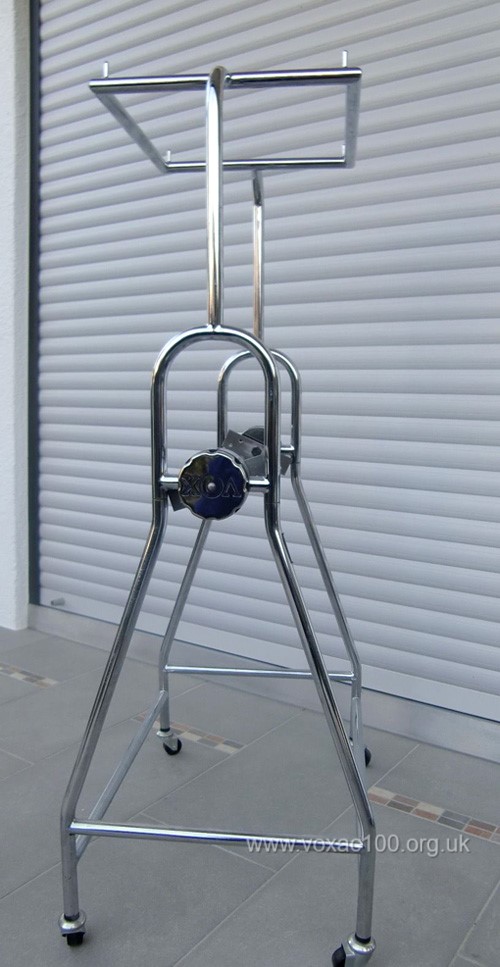
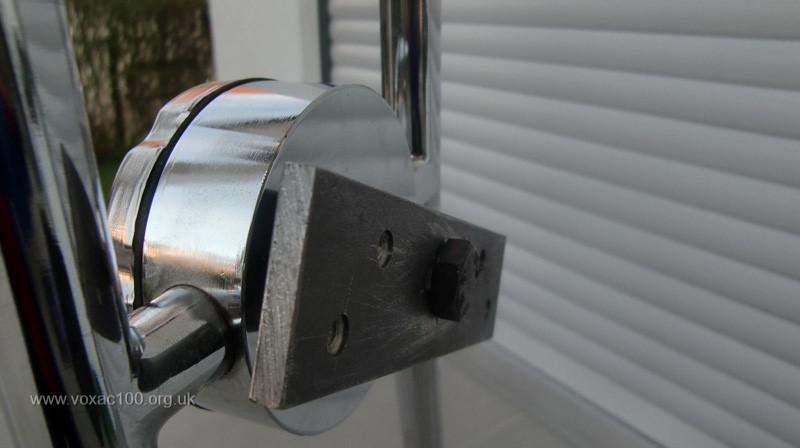
A trolley that came up for sale in 2015 - not a common or garden Mark 1 reproduction, but a Mark 2 with the loop of the frame high above the hand-wheel, and the basket entirely formed from sections of tube. Further details on the two types on this page.
This has every chance of being original - in other words made by JMI - but relatively late on. The cabinet fixings are of a type introduced in 1967. The castor assemblies suggest later 1960s too.
19th October
Below, some details of JMI trolleys. The drum of cabinet mount sat inside the inner drum of the trolley's side mount. Inside the inner drum of the side mount, a loose resin-hardened fibre hoop capable of revolving freely.
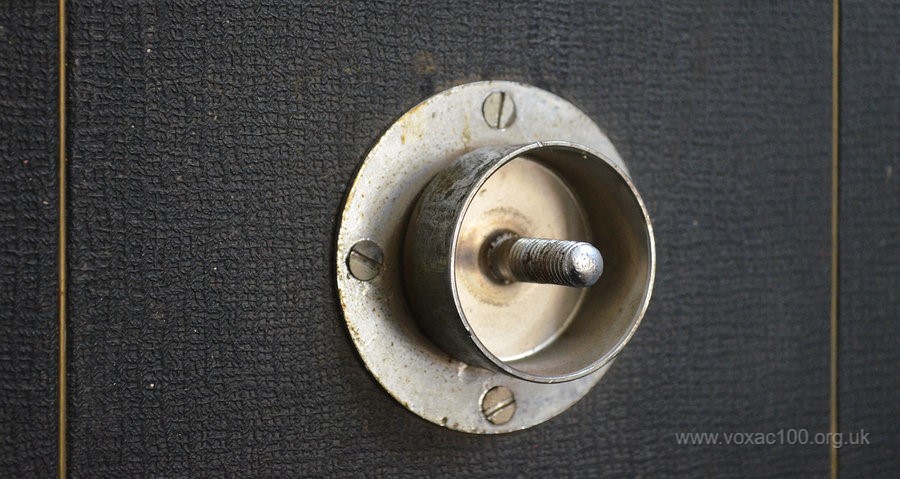
Cabinet mount, SDL cabinet from summer 1965. Dimensions: diameter 3"; body 1" tall, 1 7/8" diameter; threaded centre 1 1/2" tall; thread diameter 3/8" (British Standard Whitworth).
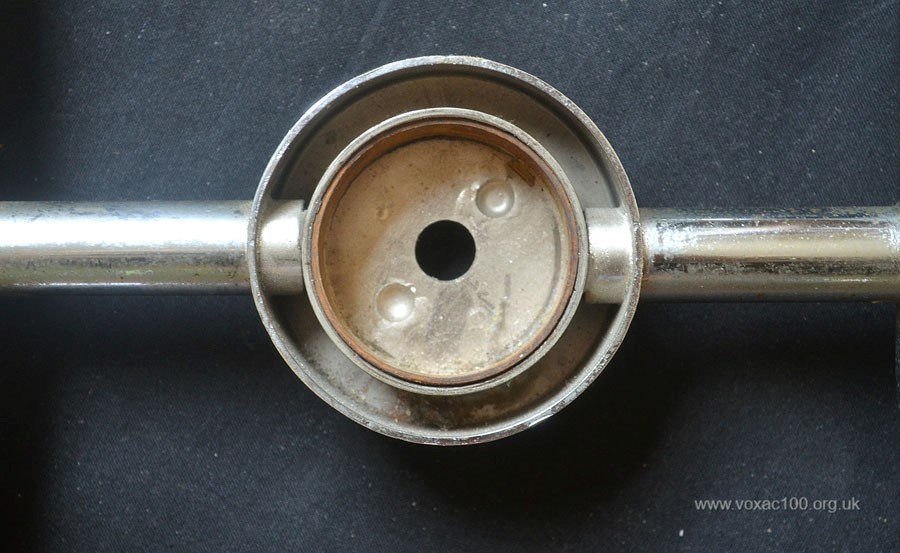
Inner diameter of inner drum 2"; fibre hoop 1/16" thick.
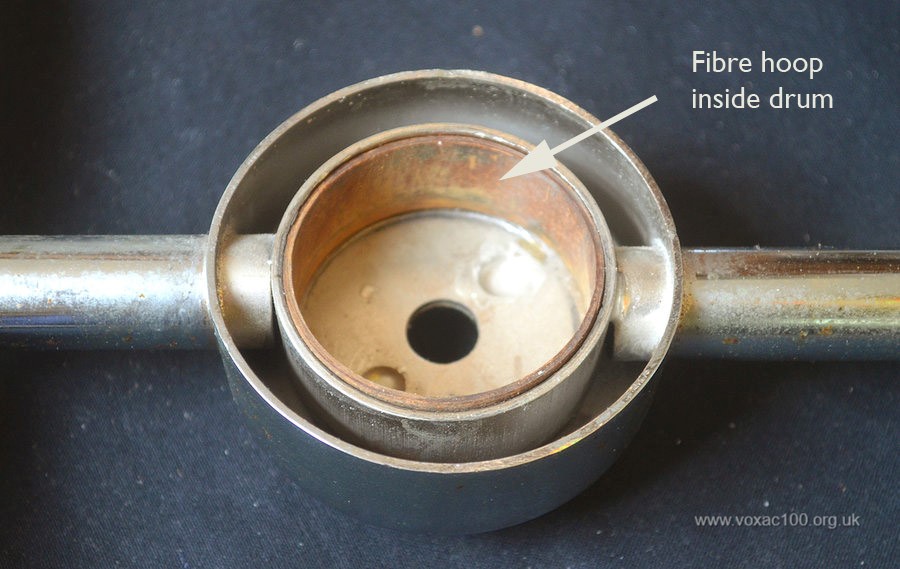
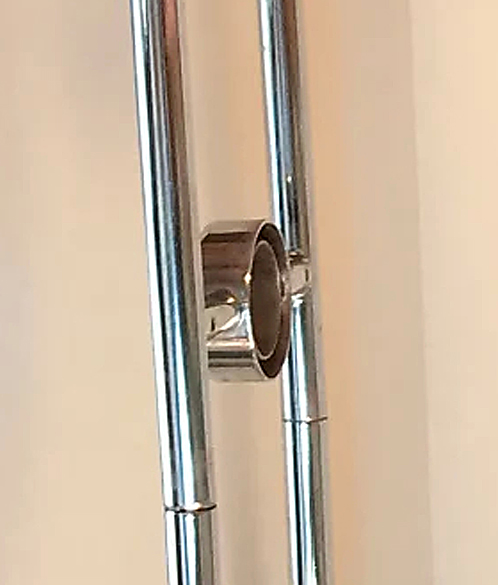
Detail from a JMI trolley, late 1965 / early 1966.
17th October
The page on AC100 SDL trolley mounting hardware has now been set up here, various notes on Thomas Organ Super Beatle trolleys interspersed.

Schema produced by Thomas Organ for the third version of the Super Beatle - V-1143.
A page of details of the schema will be posted shortly along with Thomas's numbered lists of components.
16th October
A short page collecting together some of the more accessible material on the replacement parts stocked by Thomas Organ for the AC100 SDL has been started here.
A new page illustrating the differences between JMI trolleys and the trolleys supplied by Thomas for the solid state US-made Super Beatle cabinets will be posted soon and added to the main speaker cabs index page.
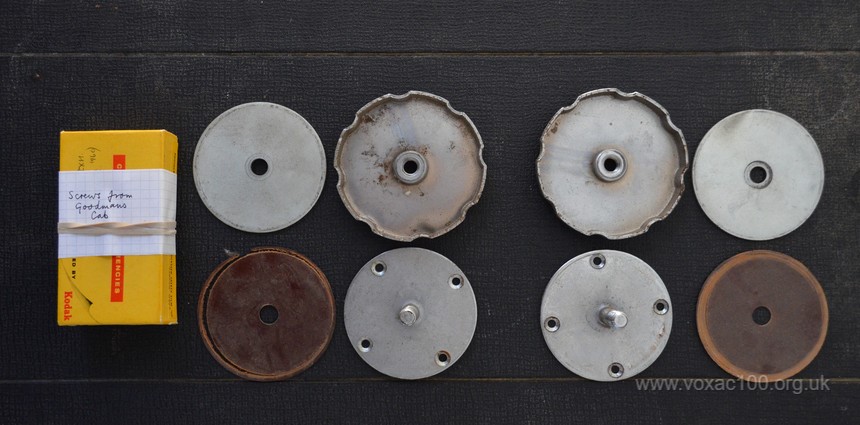
Swivel wheel hardware from a US-made Super Beatle trolley of 1967 - with distinctively American plain metal friction discs - on top of a JMI AC100 cab.
15th October
AC100 serial number 1714, produced in 1966, pictured with a nice early AC50 speaker cabinet - late 1964 / early 1965. Thanks to Ihor for signalling the existence of this amp (sold earlier this year in the USA).


AC100 serial number 1714.
14th October
A page on Vox AC100 bass trolleys (for 2x15" speaker cabinets) has now been started. A number of the older pages linked on the Vox AC100 speaker cabinets index page will be updated soon.
13th October (2)
Just to note that the page on AC100 SDL trolleys is in the process of being expanded. A number of the links have been updated. Further material to follow. A page on the various types of trolley devised for 2x15" bass cabinets will be posted shortly.
13th October
Some new pictures of AC100 serial number 2111, its circuit corresponding with JMI circuit diagram OS/167, doubled-up capacitors in the power section. See this page.
In terms of dated components: main preamp capacitor (a green TCC) - "XE" = May 1966; blue Hunts cathode bypass cap. "NYT" = 4th week of 1967. As in serial number 2093 (pics below, entry for the 9th October) certain signal/coupling capacitors are yellow Dubilier polypropylenes. In the power section, the original grey Radiospares 200uf/350v capacitors are still in place.
The chassis number is 023xx, the highest recorded so far. At least 1300 AC100s were therefore produced at the West Street Works from Spring 1965 to late 1967.
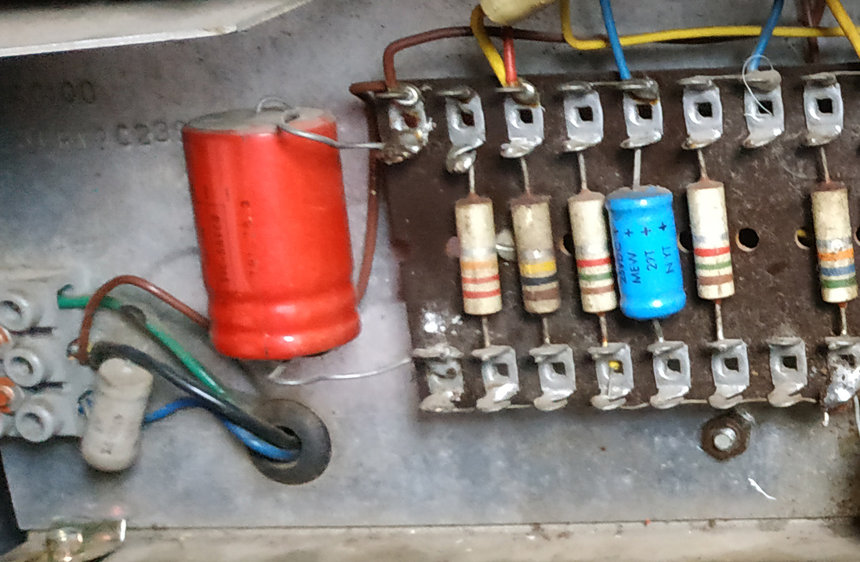
Blue Hunts 25uf bypass capacitor, date code "NYT" = 4th week of 1967.
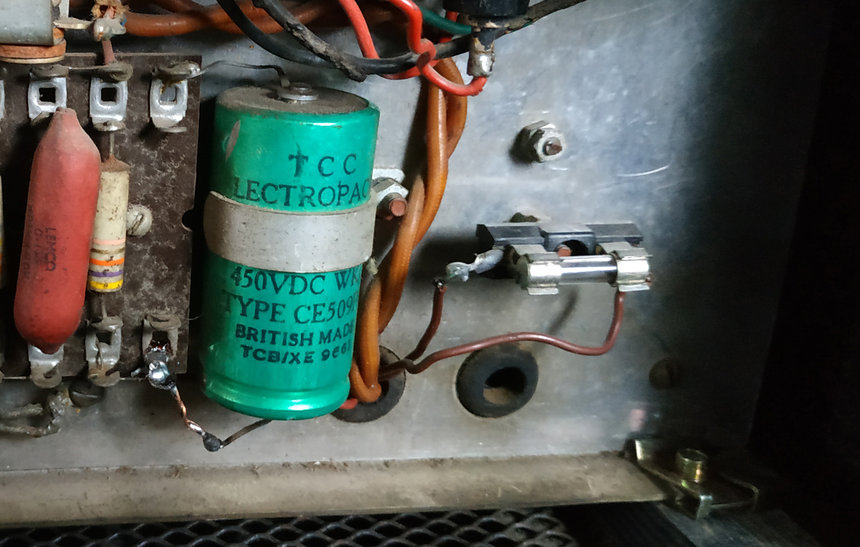
Green TCC capacitor, date code "XE" = May 1966.
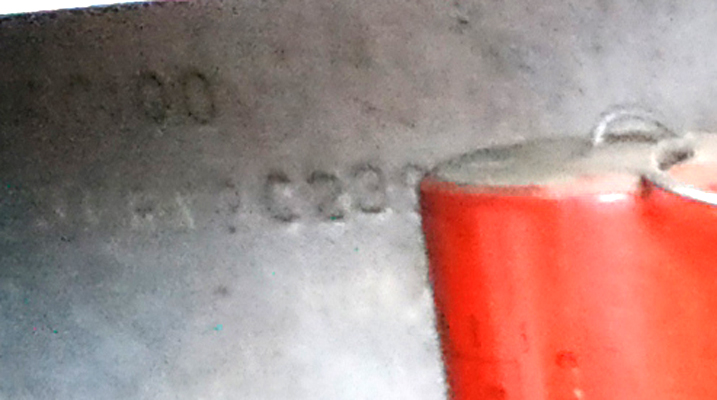
Chassis number 023xx.
12th October
A Woden output transformer, date code "JW" = September 1965, part of a batch sent to Thomas Organ by JMI in late 1965 or early 1966 for the repair of cathode biased AC80/100s that had been exported to the USA earlier in the year - amps with serial numbers in the range low 200s to around 450, black and grey panels.
"79806" is the JMI part number. The original batches of transformers used in the black panel cathode biased amps have date code "KV" = October 1964, those in the grey, "BW" = February 1965. Although the output transformer used in the former had a more complex internal structure than the one adopted some months later in 1965, the later type would have been a more than adequate replacement. Woden generally produced runs of 60 or 120 units for JMI. The Thomas Organ part number for the AC100 output transformer was 09-5602-0.

Woden transformer, manufactured in September 1965, fitted in the USA at some point to AC100 serial number 2098, one of the last AC100s produced.
11th October
The box of AC100 serial number 1767, probably early to mid 1966, original back panel fittings still in place. Amplifiers close in sequence can be seen on this page.


The box of serial number 1767. Pictures from this page.
9th October
Below, pics of AC100 serial number 2093, mid 1967, exported to Europe (as many late AC100s were). The amp is likely to have been built to circuit diagram OS/167, doubled up capacitors in the power section. Pictures of serial numbers 2094 and 2095 can be seen on this page.


AC100 serial number 2093.
Chassis number 2282, no date codes visible in the preamp unfortunately, but note the presence of yellow polypropylene Dubilier coupling capacitors, also used in the Vox range of solid state amplifiers. The 2x15" speaker cabinet has a new-style solid state logo.
8th October
Thanks to Kit, pictures of AC100 serial number 256, black panel, produced in early 1965. The Woden mains and output transformers have the date code "KV" = October 1964, and the choke "LV" = November 1964. The amp is likely to have been shipped to Thomas Organ's Sepulveda factory/service centre soon after production.
It was bought from Apex Music in San Diego, an important Thomas Vox dealer, in the mid 1970s. The story told then was that the amp had been present at Balboa Stadium on 28th August 1965, serving as backup (if needed) for The Beatles and returning to Apex Music afterwards.


AC100 serial number 256.
Interesting to note that Apex apparently had an AC100 on show at the San Diego Teen-Age Fair, Vacation Island, 29th August 1965 - the trolley probably with an early basket top.

Apex Music / Thomas Organ Vox promotional stand, San Diego Teen-age Fair, 29th August, 1965 - the slogan: "Vox. The British Sound". The catalogue of that name had not yet been issued however.
7th October
Thanks to Henning, further pictures of AC100 serial number 2022, now nicely restored.


AC100 serial number 2022.
4th October
A page of the early AC100 SDL speaker cabinet and trolley has now been set up here.

Date code of one of the Celestion T1088 speakers - "15KJ" = 15th October, 1964, which relates of course only to the manufacture of the speaker, not the cabinet as a whole.
2nd October
Thanks to John, pictures of his superb find: an AC100 SDL speaker cabinet and trolley from late 1964, the trolley of the earliest type (mark 1) with narrow parallel side bars and a basket top for the amp to sit in - one of only two known at present. The date codes of the Celestion T1088s are 15th and 16th October 1964.
JMI made very few AC100 SDL cabinets and trolleys in 1964 - four in early August (two for The Beatles), and no more than six later in the year. They were reserved for loan and promotional purposes - see this page. At least one went to Thomas Organ in America in early 1965. That is the other that survives - pictured here.
In terms of sales, AC100 SDLs did not really get going until mid 1965, and then mainly in the USA and Europe. In the autumn of 1965, The Who was still the only major band in the UK besides The Beatles to have its own, though it has to be said that Pete Townsend's amps and cabs were occasionally borrowed from/provided by JMI. AC100s for bass and PA sold much better early on.
A new page with further details and notes to follow.

1st October
Below, a copy of the JMI circuit diagram for the preamps of the all-valve Metal Clad Public Address amplifiers - the MC15/4, MC30/4, MC50/4, MC100/4 - in the period mid 1965 to early 1968.
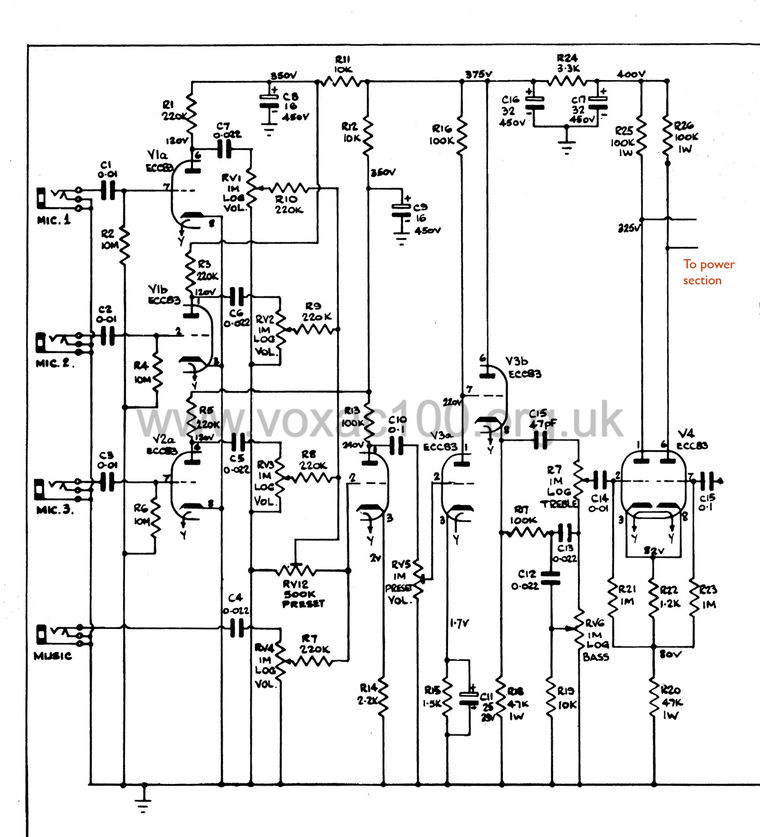
Vox Metal Clad preamp, mid 1965 to early 1968.
From an electronic standpoint, the design of the phase splitter is much the same as the one adopted by Derek Underdown for the AC50 marks 1 and 2 (late 1963 and mid 1964), which tends to suggest that the preamp of the MC changed little after 1964 (when the range was first released).
The power section of the MC50 is likely to have been updated at least twice however - a mark 1 (late 1963), mark 2 (summer 1964), and mark 3 (1965) running in step with the revisions of the AC50. See yesterday's entry.
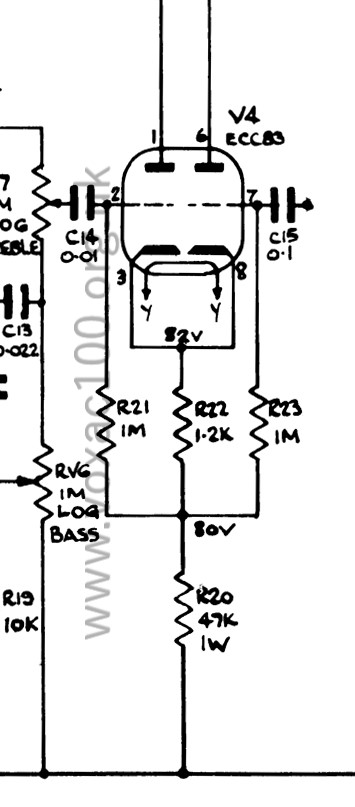
Metal Clad phase splitter.
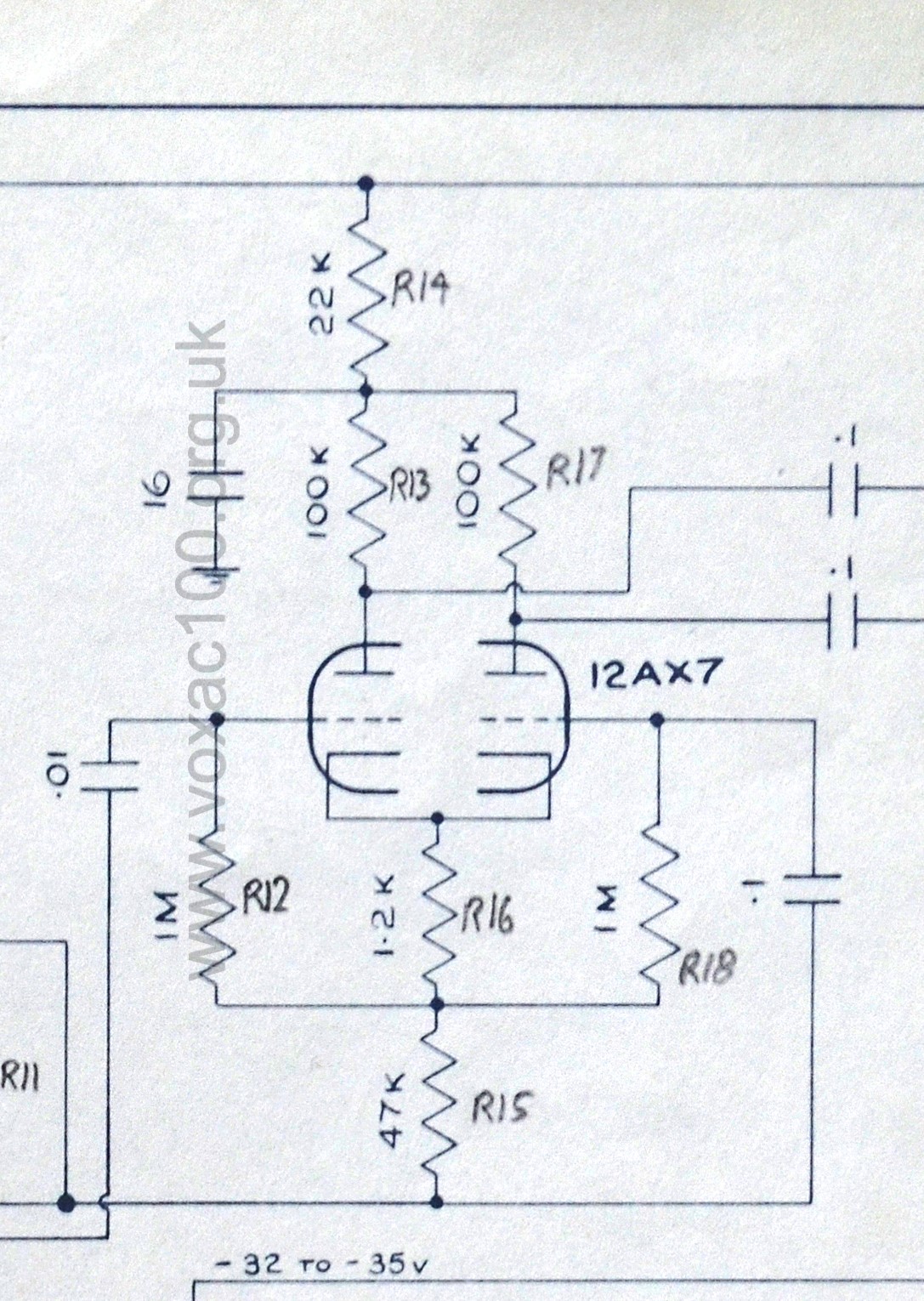
AC50 mark 1 phase splitter.
30th September
The page on the early Vox MC50/4 - 50 watt Metal Clad Public Address amplifier - is in the process of being updated.
As noted below on this page (3rd July), the preamps of the MC30/4, MC50/4 and MC100/4 were identical - modular in nature. It is likely that from mid 1965 the M15/4's was too. Power amps were necessarily different, within the range at least. From mid 1965, the MC50's was effectively (but for a few minor details) the same as that of AC50 mark 3 (OS/072). Its form in 1964 - whether solid state or valve rectified - is not known at present.
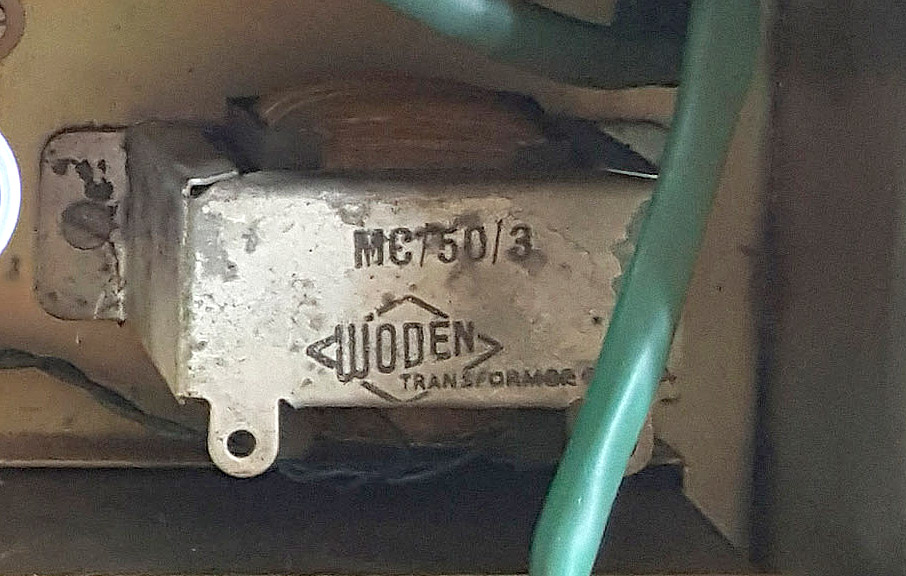
It is worth noting though that by late 1965 / early 1966, the MC50's circuit was apparently into its third formulation, as marked on the Woden choke pictured below:
27th September (2)
Good original pictures of the Raiders on Leo Carillo State Beach in February 1965 are held by Getty Images. The Getty captions say the scenes were taped on the 13th February.
27th September
A still of Paul Revere and the Raiders from the pilot episode of "Where the Action Is", printed in "Vox Teen Beat" magazine, no. 2. The band mimed in front of an AC30, AC50 Foundation Bass, and Continental organ in two segments. IMDB indicates that the pilot was taped on Leo Carillo State Beach (Malibu) in February 1965. Presumably it aired on national television soon after. The first episode of the main series was broadcast on 28th June '65 - see this page. Wikipedia unfortunately has its dates askew.
The pilot is likely to have been the first time a general teenage TV audience in the USA saw an American band with Vox equipment. A smudgy digital copy of the show can be seen on youtube.

Malibu, February 1965. For a link to good original photos, see the entry above this one.
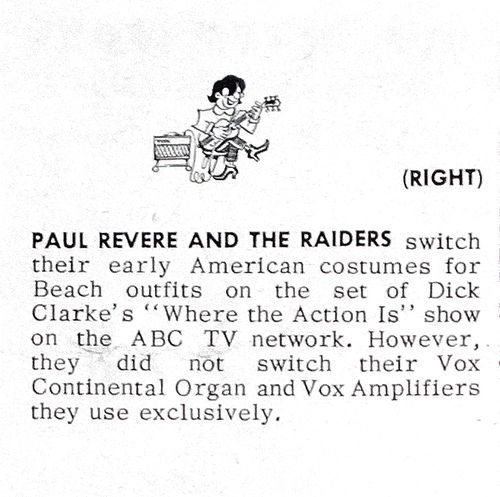
The text that appears in the magazine to the picture's left.
25th September
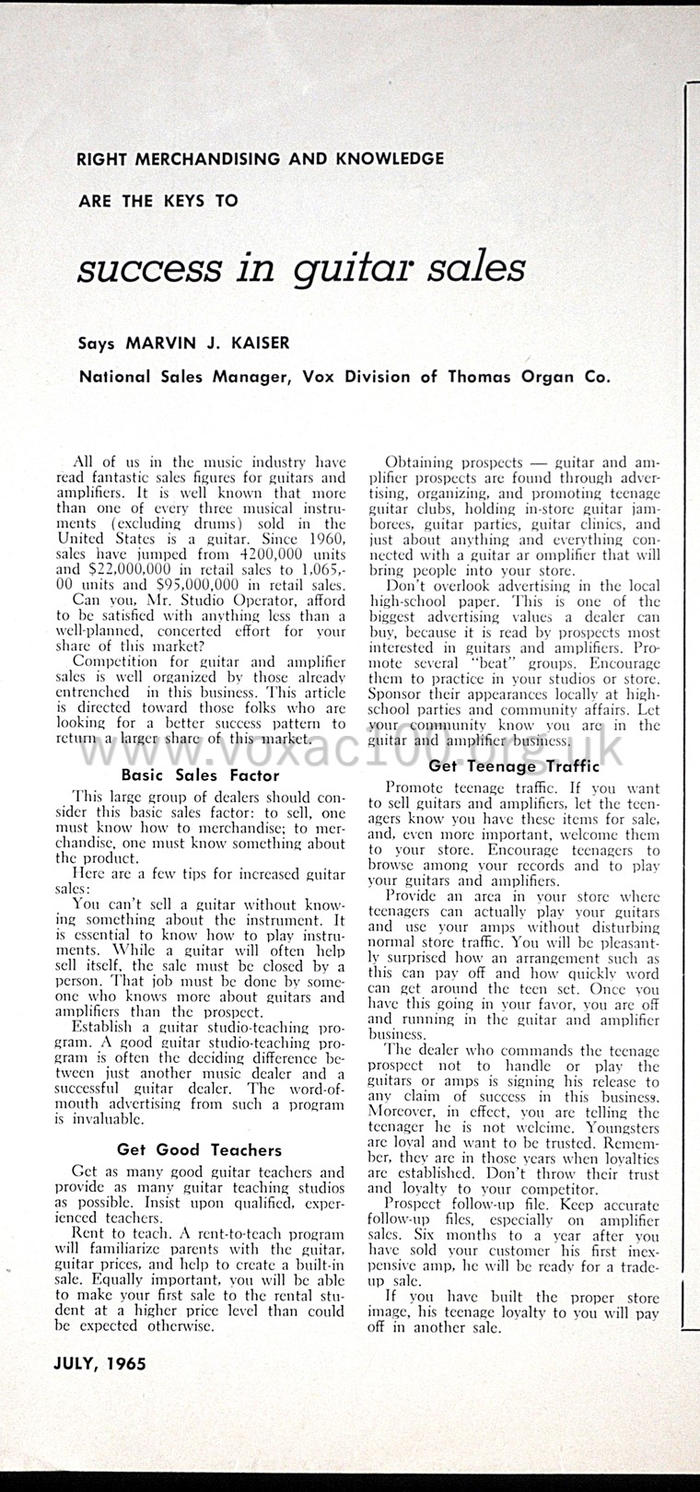
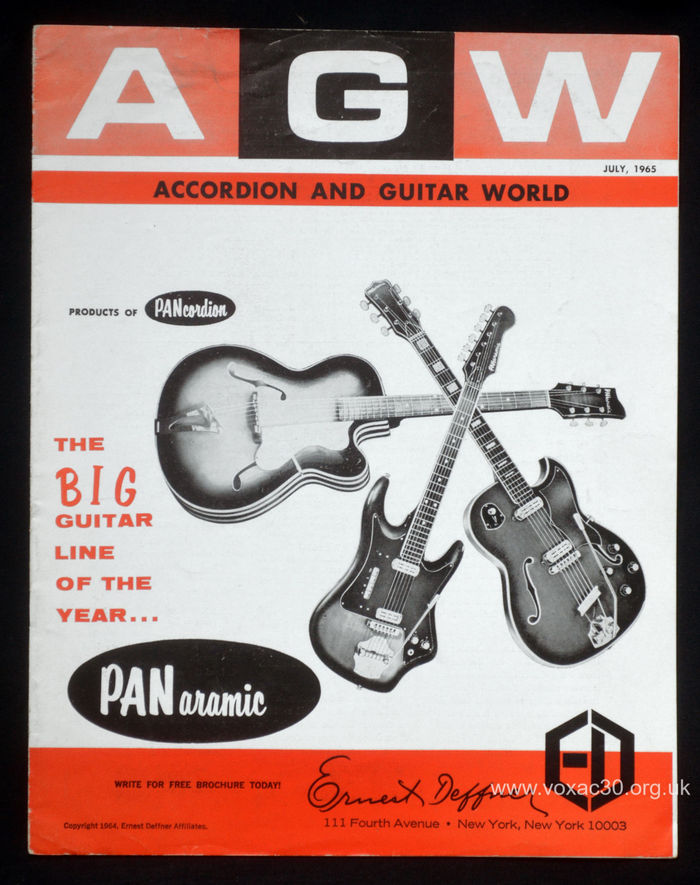
A piece by Marv Kaiser, National Sales Manager of the Thomas Organ Vox Division, on the business of selling guitars - "Accordion and Guitar World", July 1965.
Marv's first major event for Vox in the USA, was the "Battle of the Bands", mid March to 16th April, San Mateo Fairgrounds and the Hollywood Palladium in LA. See this page. Competitions, demonstrations, band battles, and promotional events staged by dealers followed thick and fast.
23rd September
There is now a general introductory page on the Jennings 050 , solid state, 40-50W, designed for use with Jennings organs. Forthcoming pages on the O100 and B50 will probably be fairly short.
22nd September
The page on the Jennings B100 bass amplifier has now been updated. Powerful and light, modularity of design was key. The O100 (for organ) and the PA100 had identical power sections. From an electronic standpoint, only the preamps were different. Were it not for the presence of the name of the model on the front panel, it would be impossible to tell B100 and O100 apart. In early 1969, the B100 and O100 were redesigned. The PA100, however, retained its initial form form through to the early 1970s.
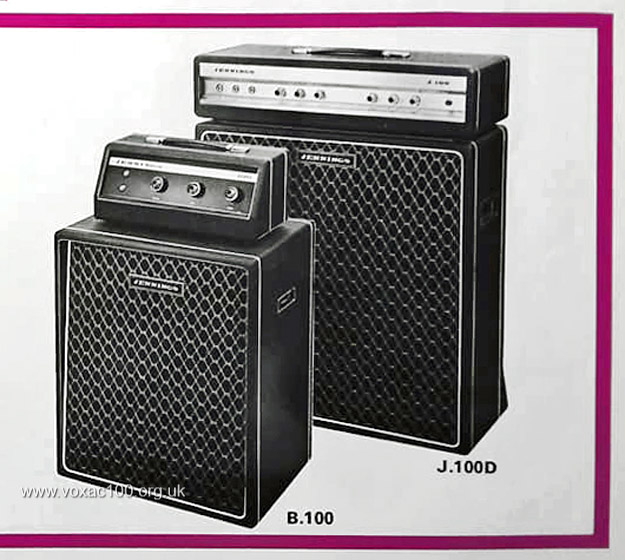
First version of the Jennings B100, illustrated in the brochure produced in advance of the Frankfurt Trade Fair of late February 1969.
21st September
The page on the Jennings J40 has now been updated. Further instances of surviving amps to be added.
Early amplifiers were quite different from later (standard) ones. The key is in the early catalogue description - "auxiliary inputs are for tape recorder....". These auxiliaries were on a rear control panel (as in the example below).

Detail from the Jennings Electronic Developments catalogue of late 1968 / early 1969, produced in advance of the Frankfurt Trade Fair of late February.

An early Jennings J40, secondary panel at rear. The central cut-out is similar to the ones that Dick Denney devised for the Beatles' early AC50 speaker cabinets.
20th September
The pages on the Jennings J100D amplifier anbd the Jennings J100 combo have been updated. The page on the J40 to follow soon.

A striking advert for the J100 combo published in February 1970 to coincide with the Frankfurt Fair.
14th September
Also posted on the Vox AC30 website, thanks to Dan, pictures of one of a pair of Celestion T1088s with the date code "12EJ" - 12th May 1964, the earliest definitively known so far, pre-dating the entry for the model (a revised T530) in the Celestion register - the "T" book" - by a fortnight. The next earliest known from pictures are "20EJ". See this page.
The report of one (or a pair) dated 13th April 1964 made by Jim Elyea needs verification (pictures). Some of the info supplied in answers to his questionnaires was evidently not always accurate unfortunately - not Jim's fault.
The pair dated 12th May came in AC30 serial number 14334T and are likely to have been original to it.


12th September
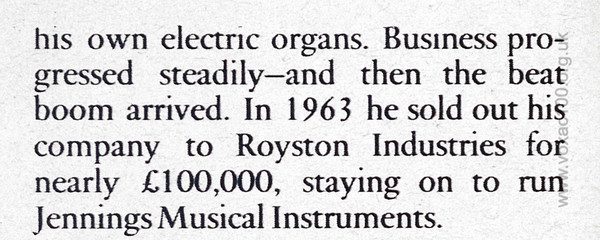
May 1965, one of the only published notes in the mainstream press on the financial side of the Royston deal - almost £100,000.
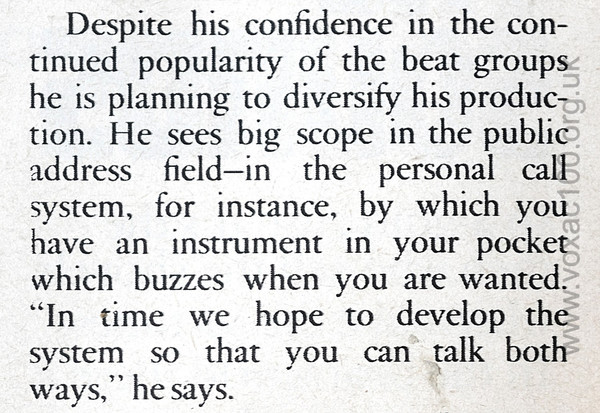
Tom later touched on his intention to build on the Public Address, more particularly paging side of things. The pricelist below (posted on this page earlier this year) seems to indicate that JMI had already made advances in that direction:
That the venture was important can be judged from the fact that in late 1964 / early 1965 Tom formed a new company - "Vox Sound Equipment Limited" - with Eric Summer, chairman of Royston, to take the the PA side of the business forward. A brochure was printed for dealers (building on a series of adverts placed in the music trade press in late '64) and new designs developed, two of which were unveiled at the Russell Hotel Trade Fair in August 1965.
But in many respects JMI's market remained relatively narrow - for the most part bands and relatively few installations - and it was probably in view of that that that Tom let the company's membership of the "Association of Public Address Engineers" lapse in the summer of 1966.
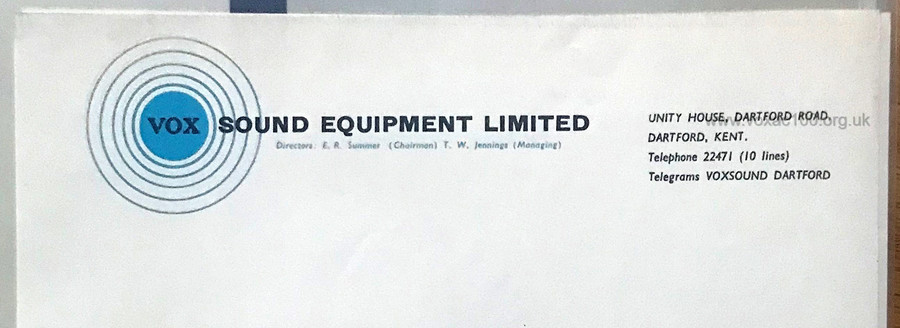
Letterhead of "Vox Sound Equipment Limited", probably early 1965. Thanks to Martin Kelly for the image.
8th September
Copied over from the Vox AC30 website, a couple of screengrabs from film segments shot at 115 Dartford Road in early 1965 - the testing of a Vox Continental organ in one of the booths. See the pictures also on this page. In early days, amplifiers and organs were tested principally by playing. By mid 1964 it had become the practice to check at least some of the newly-produced equipment by electronic means. This was the case also at Triumph Electronics, which assembled AC50 chassis (among other things) under contract for JMI. Indeed, at Triumph virtually all testing was done with scopes and meters.

The Continental is hooked up to a T60 amplifier and speaker cabinet for testing.

Left to right, Heathkit AG-9U signal generator; multimeter (probably also made/supplied as a kit by Heathkit); oscilloscope.
Further pictures of Dartford Road and the West Street Works at Erith to come.
5th September
Just to signal that three pages on Jennings valve amps of the early/mid 1970s have been updated - the AC15 (V15); the V30; and the V100.
The amplifier pages gathered here are next in line for updating (long overdue), a good amount of new material to come.
4th September
Tom at the Russell Hotel Trade Fair, August 1969, with the new Jennings Electronic Industries J69 organ. The range at this point was the J68 (two manual) and the J69 (three manual, as pictured) - briefly described and illustrated in the "Jennings News" brochure printed to accompany the display at the Fair. Early adverts, however, tend to show the organs without model number.
In early 1970, the J68 and J69 became the J70 and J71 when "walking bass" was added to the lower manual. The "J" prefix it should be said goes right back to the early days of the "Jennings Organ Company". Tom's first organs, 1953-1955, were the J48-J52. For an overview of the early organs, see these pages on the Vox AC30 website.

Published September 1969. Note the white "Attack Percussion" add-on box under the keyboard at left.
3rd September
September 1972, a Jennings Electronic Industries organ pictured in white with matching rotary speaker cabinet - probably exhibited at the Russell Hotel Trade Fair in August. The new livery was a somewhat delayed response to Vox, which had brought to market a Riviera I organ and Gyrotone set in white by late 1969.
The organ in view is intriguing - a two manual J72 (not a J71 as indicated in the report). The two manual J72 was advertised in early 1973.
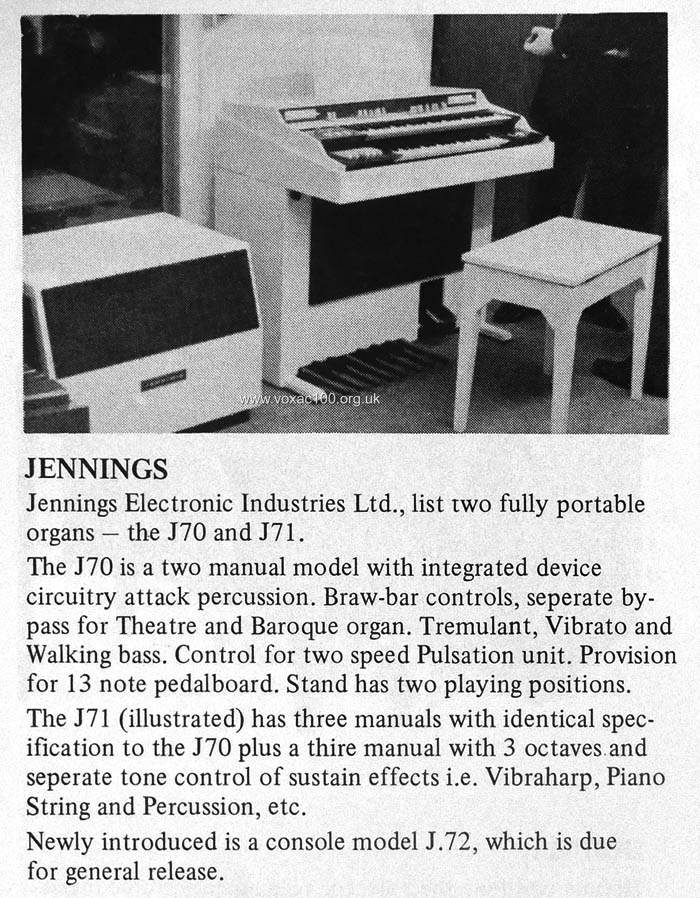
Published September 1972, picture probably taken in August 1972.