

VOX AC100 - UPDATES AND NEW INFO
April to June 2020
26th June
Back to the early days - "Jennings Musical Instruments". A couple of pieces from "The Accordionist" magazine (a Jennings publication) on the deal made with Excelsior Accordions. Trouble in River City.

"The Accordionist and Harmonica Player", Vol. 1, no. 2, June 1949. A youthful Tom Jennings signs a distribution deal with the Excelsior Accordion Corporation.

"The Accordionist and Harmonica Player", Vol. 1, no. 9, February 1949.

Detail from the advert above - a remonstration.
25th June
Picking up from the entry for 7th June further down this page, it turns out that Thomas Organ did indeed own or at least use the premises taken over by "Sound City" Studios in 1969. 15456 Cabrito Road was the "Vox Soundlab Studios". Thanks to Glen Beauchamp for the info, and the pictures of the brochure, below. Thomas seems to have been there for a short time only - from summer 1968, doubtless being part of the shake-up of the "Vox Division" (see the foot of this page), to summer 1969.
"Sound City" therefore took over an existing studio complex rather than a Thomas assembly line.


Front and middle pages of the brochure. Thanks to Glen for the pics. The last page - "Terms and Conditions" and so on - will be available on a new page devoted to the "Soundlab".
By late 1968, the "Soundlab" had become the "Vox Recording Studios". At present, the latest mention of Thomas in connection with the premises seems to be from August 1969 ("Billboard" magazine, 30th August, 1969), but as that is just a list/directory of studios, the reference to Thomas's being there could well be out of date.

"Billboard" magazine, 31st December, 1968. "All you have to bring is your talent" - a great line.
24th June
An eyewitness account of the manufacture of the earliest Vox PA mixer units, as illustrated in the catalogue of 1964, below.


Detail from the JMI catalogue of 1964.
David's account of the early units
"The first mixers I made were like the one in the brochure as picture 2. I first made these in my front room at home and they were built on small veroboard panels for each channel. Jennings supplied all the parts but not the case which they had made by their usual case makers and fitted at their works. May have been Glocks in Crayford that made the wooden boxes. The front panels were made of Traffolyte engraved by Dartford Engraving Company who had a small workshop unit behind a house almost opposite the Jennings music shop. Don't know who made the chassis and brackets. I think I made about 50 but may have been less as they wanted to test the market."
"The parts were "cheapest they could find" with germanium transistors at the time. I built these for a company called EvT who had a camera shop in Bexleyheath and they also did film striping and made, under license, a film sound adapter for adding sound to 8mm film. I got involved building/repairing the electronics for them. I then went full time with them and we made the later mixers in a grey metal case and a proper printed circuit board this time for each channel. We had problems as the channels had to be selected to have the same gain and noise levels. Subsequently I found that there was a capacitor fitted the wrong way round that caused the problem. We just copied the sample supplied and I pointed this out to Derek [Underdown]. An investigation showed that the circuit that they "copied" from a Japanese mixer was wrongly drawn. After that they worked properly. Not sure how many we made over a probable 2 years. It was at this time that the "works" moved to Erith. I discovered that most of their circuits were borrowed and sometimes modified to suit."

An old picture of a first version unit with black traffolyte panel. The mixer in the catalogue has a single tone control. This has separate treble and bass.
In 1964 Jennings joined the "Association of Public Address Engineers", attending the annual exhibition in March (and also that of March 1965). See the pages linked here. It seems possible, in light of what David recalls, that the circuit for the mixer was picked up either from the 1964 meeting, or via one of the adverts for such units in the Association's journal. Transistorised mixers were an increasingly popular thing in '64.

"Journal of the Association of Public Address Engineers", 1964. Detail of an advert for a transistorised mixer.
22nd June
The review of the BMII Trade Fair, 1969, mentioned as being in "Practical Electronics", October 1969 (below, entry for 15th May), is actually in the issue for November 1969.
17th June (2)
The page on notices of Vox in American newspapers, March 1965, is available here. The "Arlington Heights Herald", Chicago, 25th March, preserves what may be the first dateable mention of the "Million Dollar Sound", the headline "title" given to the first Thomas Organ Vox catalogue.
See also the entry below, 23rd May.
17th June
Some updates to the "Jennings Electronic Industries" pages on their way. Below, the Jennings advert in a 90-page musical instrument catalogue issued by Frank Hessy Ltd, Liverpool, in 1971. There is also an ad for Vox - "Vox Sound Limited" - at that time.


The photo at the top of the advert was re-used in "Beat Instrumental" magazine, September 1972 - see this page.
16th June
The opening of the shop at 100 Charing Cross Road in December 1950. Jennings - note "Jennings Musical Instruments" not yet "Jennings Musical Industries" - had formerly been at 55 Charing Cross Road.
The page below is from the handsomely entitled "The Accordionist and Harmonica Player, incorporating 'The Squeeze Box'". The magazine's office was 119 Dartford Road, in other words Jennings. Larry Macari, who managed the shop and went on to set up "Macaris Musical Exchange", contributed many articles and was probably the editor.

"The Accordionist and Harmonica Player", December 1950. The photo, Tom Jennings at left, was taken by the photographer of the "Musical Express", i.e. what was to become the "New Musical Express" .

13th June
"Thomas Organ" Vox Service Bulletin, no. 8, issued on the 6th December, 1965. American equivalents for British valves and transistors.
The transistors are of course those of the Vox T60 bass amplifier. Note that no equivalent is expressed for the OC35.

7th June
It is interesting to find that in the documentary on "Sound City" Studios (on Amazon Prime) and on this website, the Studios' building is said to have been the place where Vox instruments - i.e. those made by "Thomas Organ" - were assembled. The address of the Studios in the 1970s was 15456 Cabrito Road, which is some drive away from the huge "Thomas" complex on Hayvenhurst Avenue, Sepulveda, as Van Nuys airport lies in between.
A picture of the Hayvenhurst Avenue site can be found here. It is possible of course that Thomas owned or perhaps leased the Cabrito Road building for a time. If so, the site must have been vacated by 1969, the year in which the Studios came into being.
Quite what this notice in the "Van Nuys News", 6th April, 1969 has to do with it is hard to say. It would be good to have some hard and fast documentary evidence.

"Van Nuys News", 6th April, 1969.

"Sound City Studios" in the 2000s.
2nd June
The page on adverts for Vox placed by American dealers in newspapers in February 1965 is now here. Pages on March, April and May will follow soon.
25th May
A sort of index / chronology page for Thomas Organ and Vox, 1964-1966, has been started here, its main focus being things relating principally to English-made Vox amps.
24th May
While the page on ads placed by Vox dealers in North American newspapers in February 1965 is being assembled, just to post the note below from the "Philadelphia Daily News", 1st February, 1965.
It is interesting to see that the consignment mentioned was on its way by sea, "still on the boat". Some consignments, as one might expect, came by air. It may have been a case of air initially (as the race was on to get the equipment across the Atlantic), then shipping by sea as time went on (to build up existing stocks).
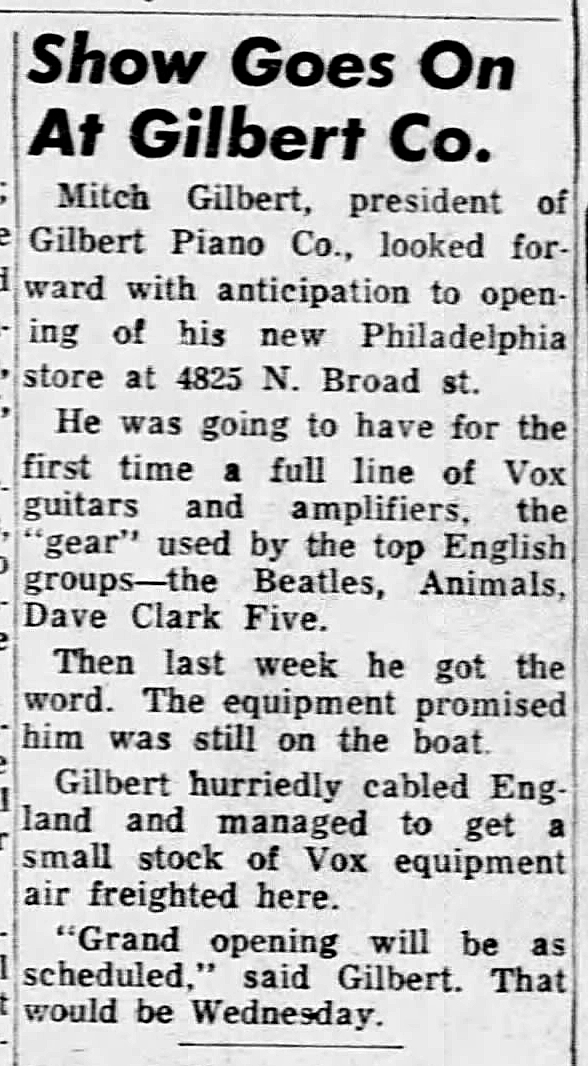
"Philadelphia Daily News", 1st February, 1965. The "full line of Vox guitars and amplifiers" was probably the range of equipment illustrated in the "Million Dollar Sound" catalogue - available here.

The "Arlington Heights Herald", 17th September 1964 - three weeks or so after JMI had agreed to provide the million dollar's worth of equipment to Thomas Organ. Note "just flown in".
23rd May (2)
Below, one of Marvin Kaiser's business cards, probably from early 1965 - Vox is still "distributed in the United States".
Marv was immensely active in promoting Vox - among other things, he got the Vox van on the road (see this page), arranged the "Battle of the Bands" competition at the Hollywood Palladium and San Mateo fairground, and visited dealers tirelessly.

23rd May
Some new pages coming along - further adverts for Vox in North American newspapers, late 1964 and 1965. The page on January 1965 is here.
Below, repeated from the Vox AC50 website, a detail from a feature - "Region Business in Pictorial Review" - in the Hammond Times (Northwest Indiana), 13th April, 1965: Hal Morris Music Mart in Lansing, Illinois, with an AC50 Foundation Bass, T60 set, and Continental organ.
Note on the back wall behind the necks of the guitars, Vox dealer photos (English bands), and to the right a copy of the Vox "Million Dollar Sound" catalogue.
The catalogue does not appear in a photo of the shop taken from much the same point published on the 23rd March, 1965, however.


The "Million Dollar Sound" catalogue, the reference being to the deal that JMI signed with Thomas Organ to supply $1million worth of equipment (around £534,000 at the time). The copy above came from Zeb Billings's Music Store in Milwaukee.

"Hammond Times", 23rd March, 1965 - no catalogue behind Hal.
15th May (2)
From the "Music Business Weekly" magazine coverage of the Frankfurt Fair, March 1970, the Jennings Attack-Percussion add-on unit for its organs, often described in JEI literature, but rarely illustrated.
In the pricelist of late 1972 its model designation is AP.1 and its price £26.25.

"Music Business Weekly", 21st February, 1970.
15th May
A short review of the "British Musical Instrument Industries" Fair of August 1969 mentioning JEI now posted here. One of the things exhibited was the "Scrambler" pedal in a pre-production form. Most of the JEI pedals of late 1968 and 1969 had rotary controls, doubtless based on the rotary foot control developed by JMI, Tom Jennings' old company, in the late 1950s.


Detail from the review of "British Musical Instrument Industries Fair", August 1969 published in "Practical Electronics" magazine, November ( not October) 1969.

A production "Scrambler" from the effectsdatabase.
14th May
The JEI catalogue of 1973 is now available here. in its entirety. The accompanying price list is on this page.
7th May
An advert placed by "Radio Component Specialists" of Croydon in "Practical Wireless" magazine, March 1978 - probably a 100 watt PA amplifier. Expressly said to have been made by JMI (so not one of the later fully solid state metal-clads made by "Vox Sound Equipment Limited" and "Vox Sound Limited") - volume, bass and treble controls, and 4 speaker outputs.


6th May
Shots of a Dusty Springfield match booklet produced for JMI by "Bryant and May" around 1966. All the matches are gone, but its first owner was careful to keep the booklet itself.


5th May
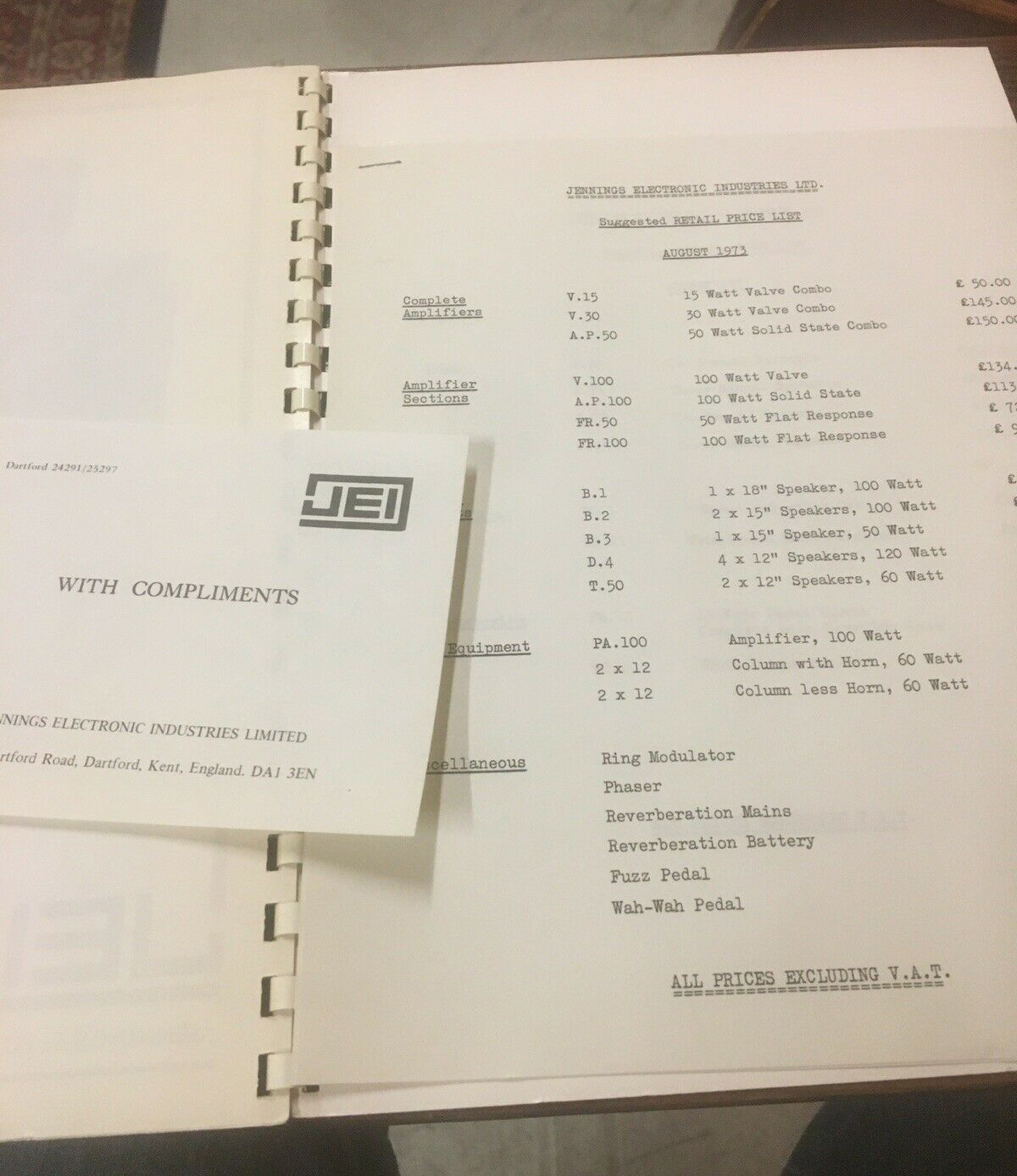
Some specimen pages from the "Jennings Electronic Industries" catalogue (and pricelist) of 1973, printed to introduce the new range of "purple" amps exhibited at the "Associated Musical Instrument Industries" fair at the Russell Hotel, August, 1973. The catalogue as a whole will be posted shortly.
For the JEI pricelist of 1972, see this page.


28th April (2)
Pictures of a Jennings J200 (very scarce these days) - purchased towards the end of 1972 and still owned by the purchaser. Thanks to Tor for the pictures and details:


The amp on stage in 1975.

Equipment on stage in 1972. It had been bought directly from JEI and shipped to Norway early in the year.
28th April
Pictures will be posted soon of a "Jennings Electronic Industries" brochure from August 1973, doubtless prepared for the "Associated Musical Instrument Industries" show at the Russell Hotel in London - the introduction of the purple line of amps:

24th April
The box of AC80/100 serial number 220 survives: thick-edged, black cloth, corner protectors, white warning plaque. The number is stamped 0220 - the "0" being an occasional prefix on early plates (0185, 0221, and a few others). The chassis currently in the box is a later grey panel AC100. Thanks to Neal for the info.
21st April
Sad news - Derek Underdown, chief engineer of JMI, passed away on 16th April, aged 92. Derek was instrumental in designing and setting up the means of producing dozens of Vox amps and keyboards, the AC100 included.
Some notes on the circuit AC80/100. There had been nothing like this amp before. Guitar and hi-fi amps (the latter mostly based around KT88 valves) rarely ran in the UK to anything more than 40-50 watts; and the large cabinet amplifiers designed and built by Vortexion and Westrex for use in cinemas and for public address generally had circuits unsuited to anything else. Interesting to note though that Westrex later assembled AC80/100 chassis under contract for Vox.
For many hi-fi manufacturers and circuit designers (including Mullard), cathode bias was a tried and tested topology - normally, for higher power amplifiers, two EL34s or KT66s in push-pull, with a resistor at the cathode to govern the amount of power dissipated by each valve. The resistor was often bypassed by a capacitor as a means (a) of limiting distortion; and (b) enhancing frequency response, though no-one at the time could quite agree on what was happening. The mathematics and physics are incredibly complex. Nonetheless a 100uf cathode bypass capacitor was generally the recommended value.
When Denney and Underdown came to design the AC80/100 in the late summer of 1963, some of the ground-work had already been laid. The preamp of the AC80/100, for instance, took elements from the top boost circuit of the AC30. But the power section - four cathode-biased EL34s - was new.
The schematic - a detail below - reveals the intention to squeeze as much power as possible from the valves. In fact, the circuit at idle exceeds the maximum power dissipation recommended by Mullard for both plates AND screens. The figures *in outline* are:
Around 425v is supplied to the plates and 410v to the screens. The 100ohm plate resistor drops the supply voltage down from 430v.
The voltage drop across the cathode resistors is 25v.
To calculate the power dissipation of the EL34s, one first has to work out how much current flows at the cathode and screen.
The current at the cathode is calculated by taking the voltage at the cathode (25v) and dividing it by the value of the cathode resistor (270ohms). 25 ÷ 270 = 92mA. The screen current is calculated in a similar way - by taking the voltage drop at screens, in this case 20v (the 430v of the power supply minus the 410v actually on the screens) and dividing it by resistance "seen" by each screen (2 x 470R = 940). 20 ÷ 940 = 21mA.
So 92mA at the cathode and 21mA on the screens. To work out the current at the plate, one subtracts the screen current from the cathode: 92-21 = 71mA.
To work out the dissipation of the valve in watts, one multiplies the plate current by the voltage at the plate minus the voltage at the cathode.
So (425-25) x 0.071 = 28.4 watts. The maximum dissipation recommended by Mullard for the EL34 is 25W. The valves run extremely hot. Screen dissipation also exceeds the recommended figure (8W).
Just to add that calculating the dissipation of the valves does not give one the power in terms of musical output. A proportion of the dissipation of the EL34s is lost in the form of heat. Although cathode biased amps sound superb, cathode biasing is not as efficient as fixed (or "grid") bias in harnessing a valve's ability to amplify a musical signal. Thus the designation of the amp as an "AC80/100" rather than an "AC100".
These at any rate are the figures that emerge from the basic equations. An AC80/100 sitting at idle (i.e. with no instrument plugged in) runs its power valves beyond the limits envisaged by Mullard. But one has to remember that the Mullards produced in the early 1960s (and their American counterparts, the 6CA7) were fantastically resilient and cheap. Valve longevity and cost were not a consideration then. And if one EL34 fails, there is always the chance that the amp will continue working, albeit at reduced power and with a distributed strain on the other three valves.
The rest is theory well beyond the scope of this entry. Simply to add that running the valves hard at idle was quite in line with the thinking of the day, the idea being that the EL34s would only occasionally be pressed harder - something that might, counter-intuitively, occur at points other than maximum volume. The musical signal entering at the grid would also have an effect on the dissipation of the valves - sometimes lessening the flow of current in the valve, sometimes increasing it.
Dick and Derek created a great amp - but finding good strong valves these days that will stand up in the original circuit is no easy matter.

A detail from OS/036 showing two of the EL34s. 410v directly on the screens. The common 470ohm screen resistor is R32. The 270ohm cathode resistors are R26 and R33, their bypass capacitors C13 and C15. The voltage at the cathode is 25v. The supply voltage (B+) of the circuit is 430v, marked elsewhere on the sheet.
9th April
Below, three out of the four JMI boosters - the elusive Mic Booster (produced in blue) still elusive. The units were sold in a blue cardboard box with a clear cellophane lift-off top. See the pictures of the bass booster further below. Boxes also contained a small information sheet, as in the instance of the Treble Booster, also below.
One can always tell English-made Treble boosters apart from American by the black rubber ring around the jack socket, the assembly of which was made by the REAN company of Dartford - a few roads down from the JMI factory at Dartford Road.
Boxes for the Vox boosters made by Thomas in the USA had plastic bottoms and hinged tops, as in the last picture in the sequence.


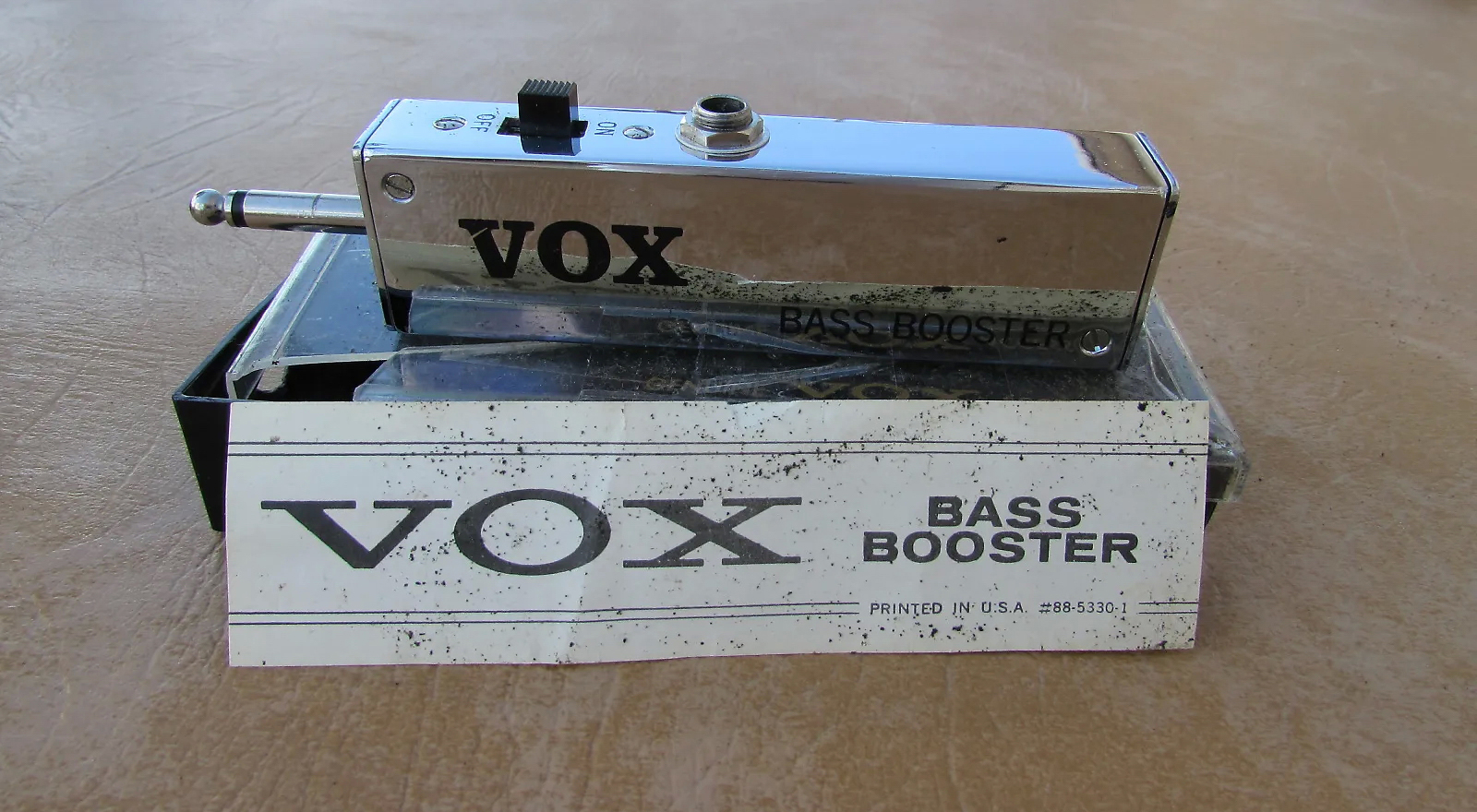
A US-made booster. Note the hexagonal metal washer and nut round the jack socket.
5th April
Below, a couple of JMI Vox dealer banners, the russet/pink and red one from 1964, the black and gold from 1965.
The standard American Vox dealer banner was similar in design to the red JMI one, but wider, and with "authorized" instead of "authorised".


The JMI banners measure 35 1/2 inches wide x 29 inches tall.

The Hollywood Palladium, Los Angeles, Easter 1965, the "Battle of the Bands" sponsored by Thomas Organ. Detail of a picture published in "Vox Teen Beat" magazine, no. 1 - the wider Thomas Organ Vox banner.

Detail from "Vox Teen Beat" magazine, volume II, issue 3, 1967.
3rd April
A set of reference pictures now available of Vox "Teen Beat" magazine volume II, issue 3, from 1967. The copy represented came from Harris Music in California, one of the first music shops to promote and sell English-made Vox equipment in the States in 1964 - see the pic below from "Teen Beat" magazine no. 1.


Los Angeles County Fair at Pomona, Disc Jockey Carnival, 25th-31st December, 1964. An AC100 with Foundation Bass cab at left. Picture from "Teen Beat" magazine no. 1, Easter 1965. The magazine as a whole is available here.
1st April
Repeated from the Vox AC50 website updates. Vox MC50 (Metal Clad 50) serial number 3901, sloping front, solid state rectified, assembled by Triumph Electronics for Vox in early 1965. Serial numbers ran in the same sequence as those assigned to AC50 guitar and bass amplifiers. Judging by small ads placed in music papers of the later 60s and early 70s, Triumph made reasonably large quantities of these Public Address units. They are scarce today however. Thanks to Daniel for the pictures.
For other MC50 and PA50s, see this page.


Note the all valve preamp and power amp. Triumph also produced hybrid Public Address amplifiers for Vox - transistor preamp and valve power amp - long before the company embarked on making the 7-series range.