Jennings Electronic Industries B100
Solid state, bass amplifier, 80-100W, mid 1968 - mid 1973
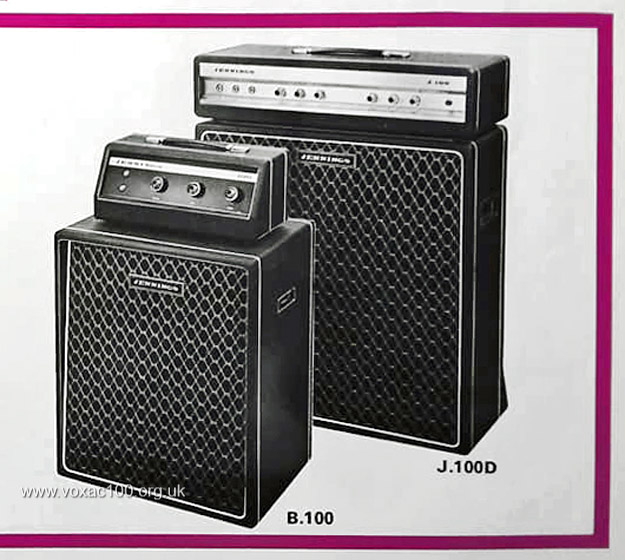
The B100 in the Jennings brochure of late 1968 / early 1969.
The Jennings B100 bass amplifier and O100 organ amplifier were evidently developed together. The two were identical in external form: both had angled fronts; black control panels; two inputs one above the other at left; mains switch at back; and controls (volume, treble and bass) to the right, Only the voicing was different. The Jennings organ amps had a markedly flat response.
Given the lack of indicator lamp on the front, it is likely that control panel was illuminated by lamps concealed above it in the overhang of the wooden cabinet. This was certainly so in the case of the PA100.
By the time of the Frankfurt Trade Fair in late February 1969, however, a new look had been introduced which can be seen in the photos below - a silver control panel, and relatively tall margins above and below. An old-style B100 or O100 just made its way into the first photo far right.

Frankfurt Musikmesse, February 1969.
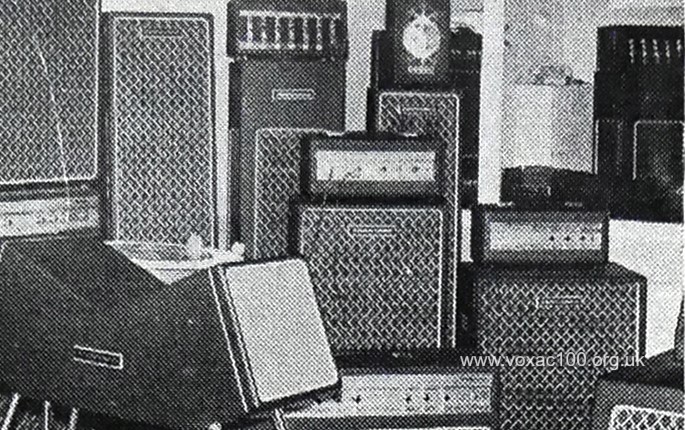
A detail from another picture printed in the music trade press.
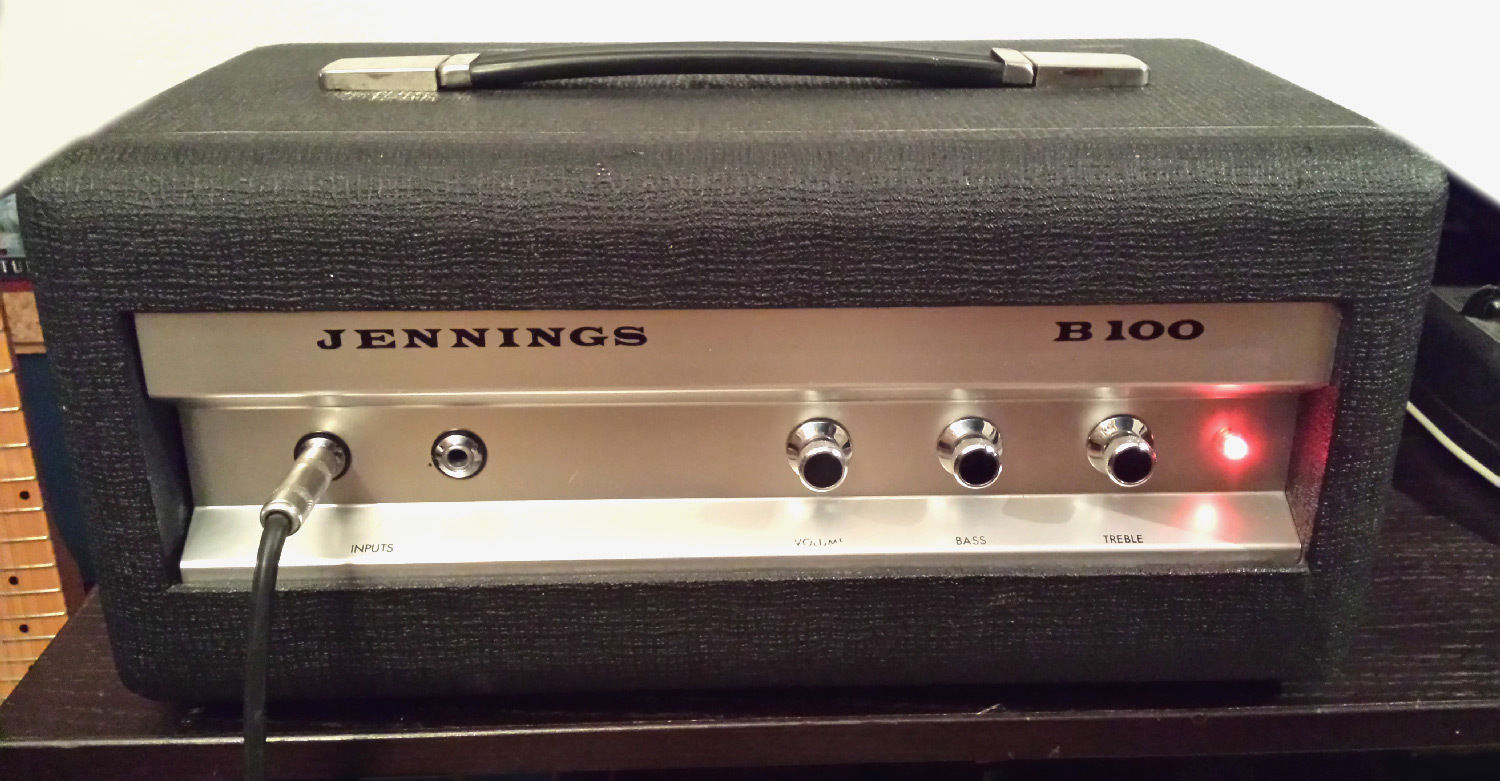
At any rate, the revamp was complete by the time of the Russell Hotel Trade Fair in August 1969. The B50, B100, O50 and O100 all took the same form (see the pictures of a surviving B100 towards the end of this page). An overview of the JEI "O" and "B" series range can be found here.
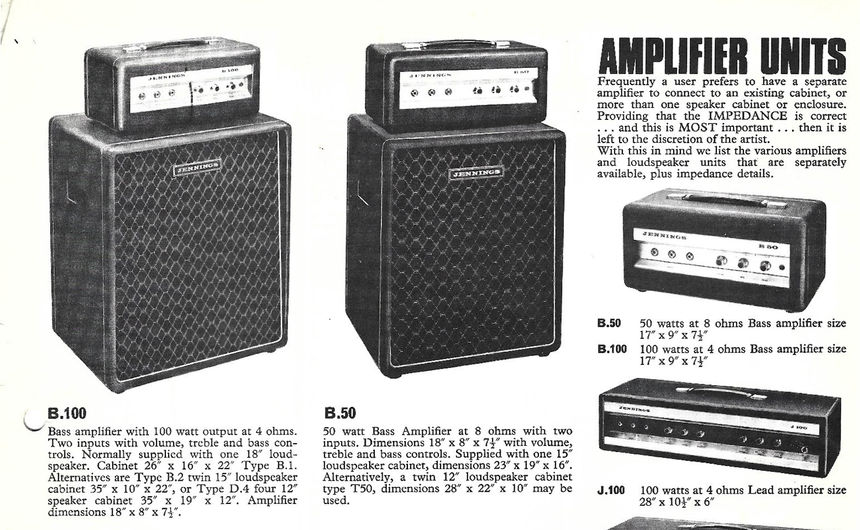
Detail from the newspaper-format catalogue produced for the Russell Hotel Fair, August 1969.
The caption reads: "Bass amplifier with 100 watt output at 4 ohms. Two inputs with volume, treble and bass controls. Normally supplied with one 18" loudspeaker. Cabinet 26" x 16" x 22" Type B.1. Alternatives are Type B.2 twin 15" loudspeaker cabinet 35" x 10" x 22", or Type D.4 four 12" speaker cabinet 35" x 19" x 12". Amplifier dimensions 18" x 8" x 7 1/2."
Tom's range of solid state amps was largely modular. The B100's power section was identical to the one used in the O100 and in the PA100. From an electronic standpoint, only the preamps were different.
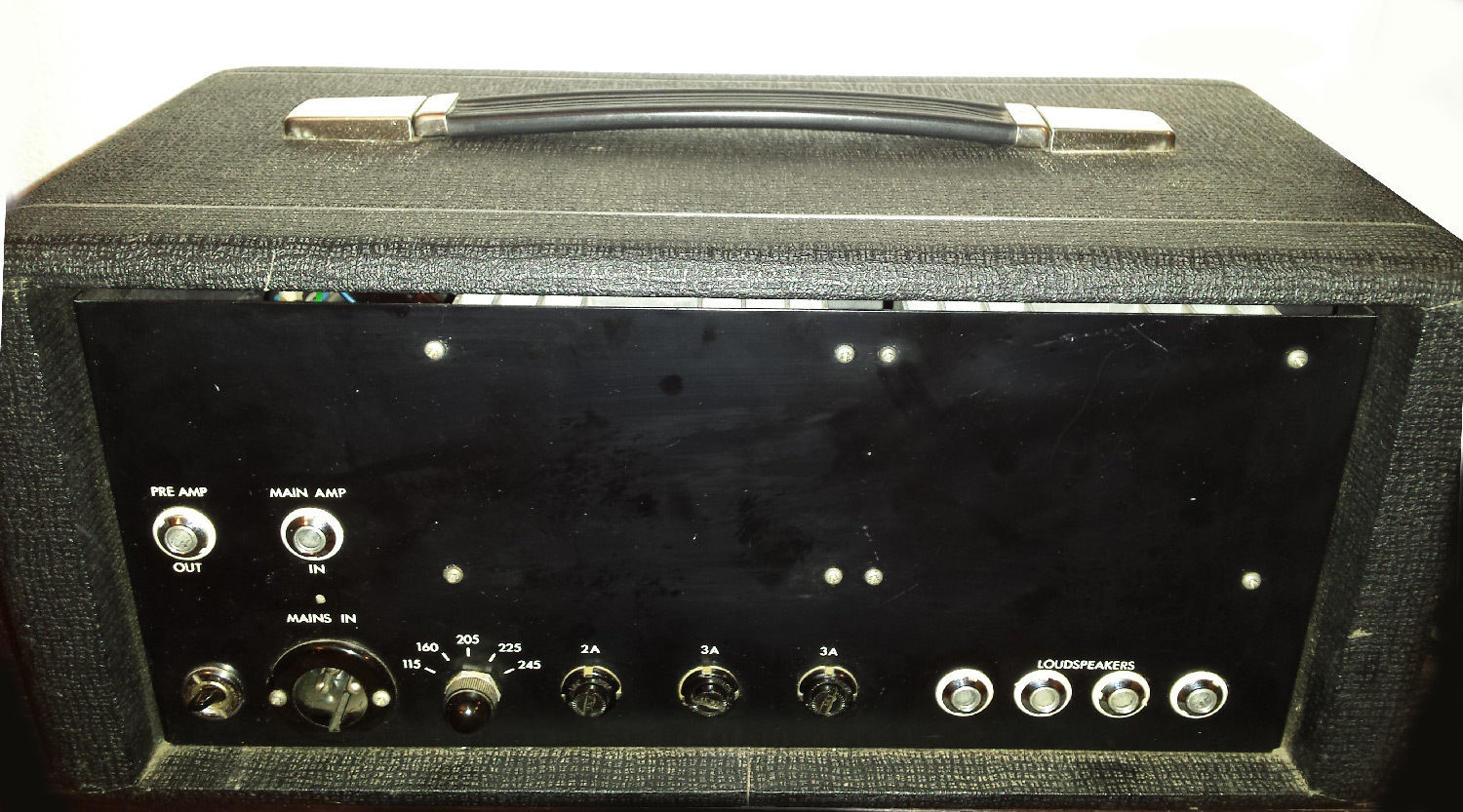
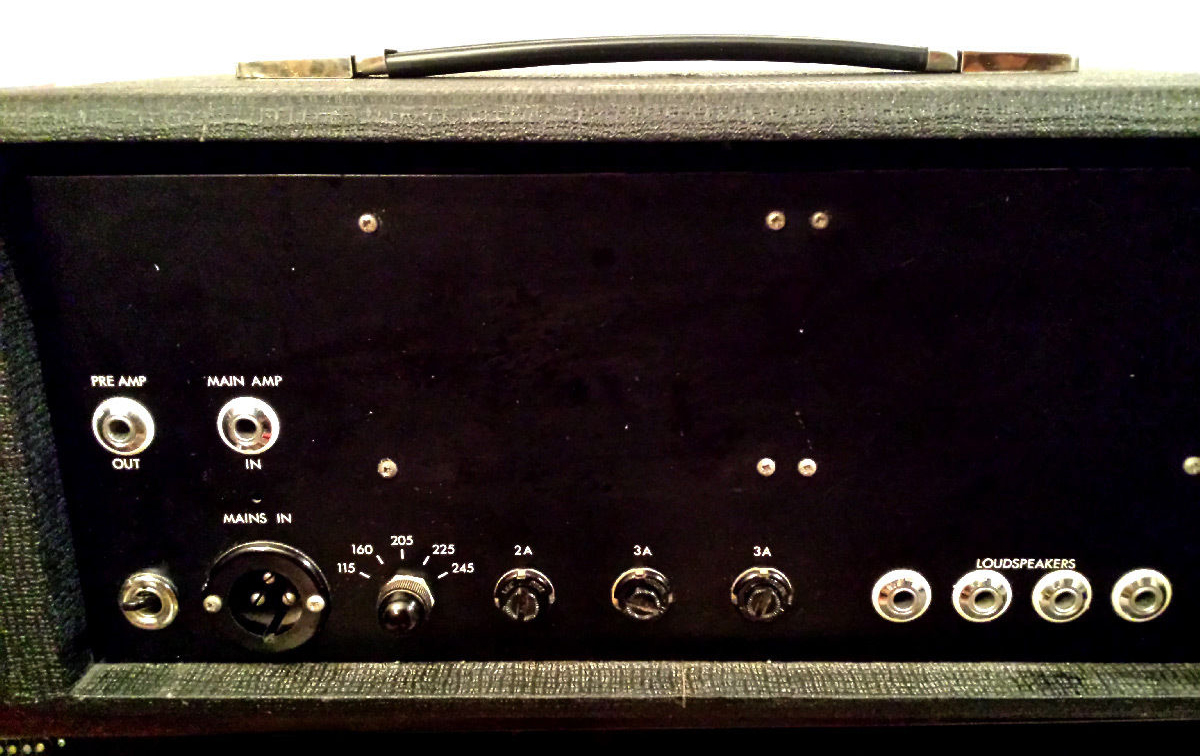
It is worth noting too that all six amplifiers - O50, O100, B50, B100, PA50 and PA100 - had preamp output and power amp input sockets, providing an unusual degree of versatility for their relative positions in the market.
Although no documentation relating to the design process has come to light so far, it is likely that the range was the work of Dick Denney and John Oram, probably in association with Triumph Electronics. The arrangement of the back panels of the Jennings "B" and "O" amplifiers is identical to that of certain solid state - "Silicon" - amps that Triumph marketed under its own and Rosetti's name.

Geoff Johnson, owner of Triumph Electronics, demonstrating Triumph's strap with built-in preamp at the Frankfurt Fair, February 1968. Rosetti was Triumph's distributors.

Triumph Silicon PA 100, front.

Triumph Silicon PA 100, rear.

Rear panel of a Jennings PA100, last third of 1968.
The 1970s
So far as one can judge, sales of the B100 were reasonable (though certainly not huge) in the early 1970s. The amp remained in the Jennings catalogue until mid 1973, at which point it was deleted, along with its fellows, the B50, O50, O100, and old-style PA50 and PA100s. The Jennings range was revamped with new designs and a striking new purple livery.

"Beat Instrumental" magazine, February 1970.

Jennings pricelist, December 1972.

Brief list of prices published in June 1973.
Surviving amps
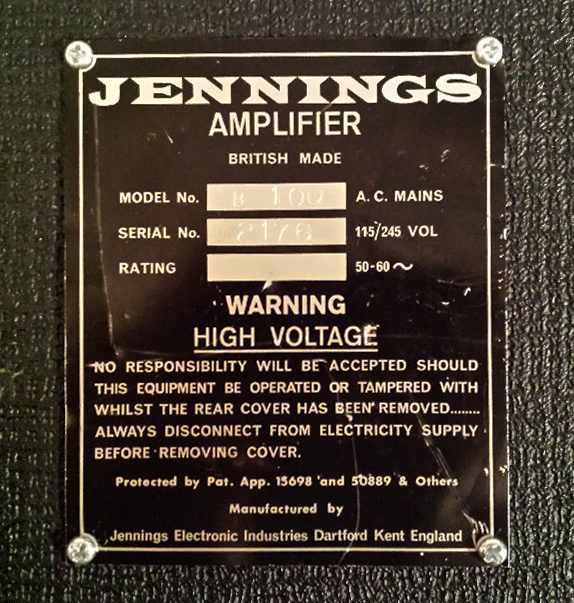
Serial numbers are likely to have started at 2000. In addition to the amp below, at least two others are known, one now painted blue and without serial number plate, the other simply from an email report, no details.
Jennings B100 serial number 2176