
JEI "O" and "B" series amplifiers
Solid state, 50 watt and 100 watt, modular in design
When Tom founded "Jennings Electronic Developments" in late 1967, he brought with him from JMI several important "designs", among which were a pair of fully solid state PA amps, modular in nature, one with a 50 watt power section, the other a 100 watter.
Below, a detail of the JMI / Vox version of its solid state PA100 at the Russell Hotel Trade Fair, late 1967.
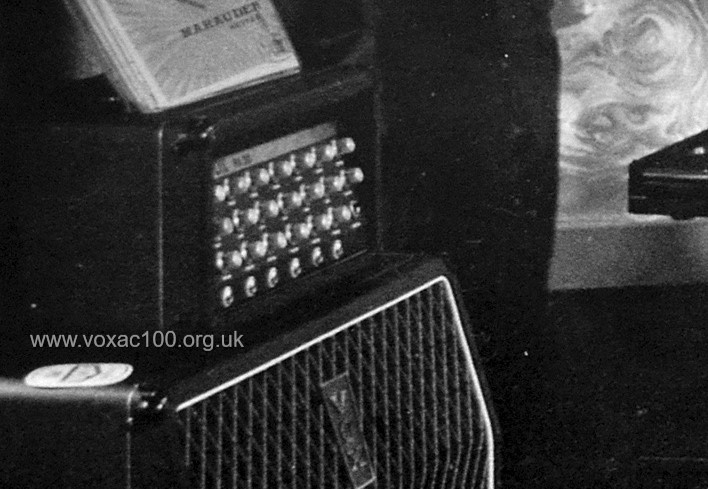
Detail from a wider view of the JMI stand at the Fair. Note that the amp has reverb.
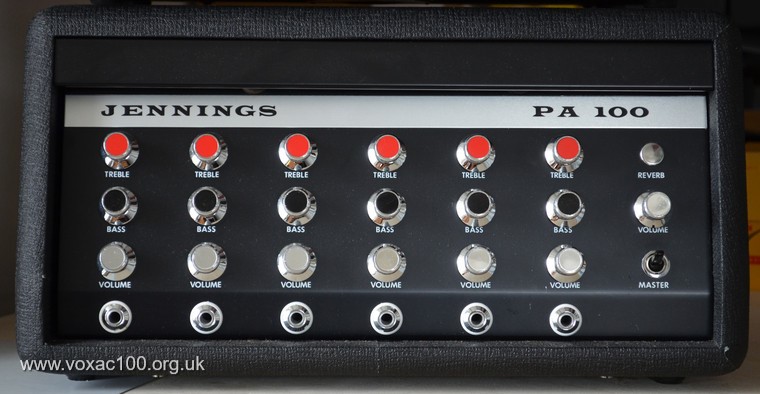
The Jennings version of the PA100 - this model without reverb (the hole for the control knob blanked off).
In terms of further developments, the PA amps were used as building blocks for Tom's new range of organ and bass amplifiers: the power serction of the 50 watt PA amp serving as the model for the JEI O50 organ amp and the B50 bass version; the power section of the 100 watt PA amp serving as the model for the O100 organ amp and its corresponding bass partner, the B100.
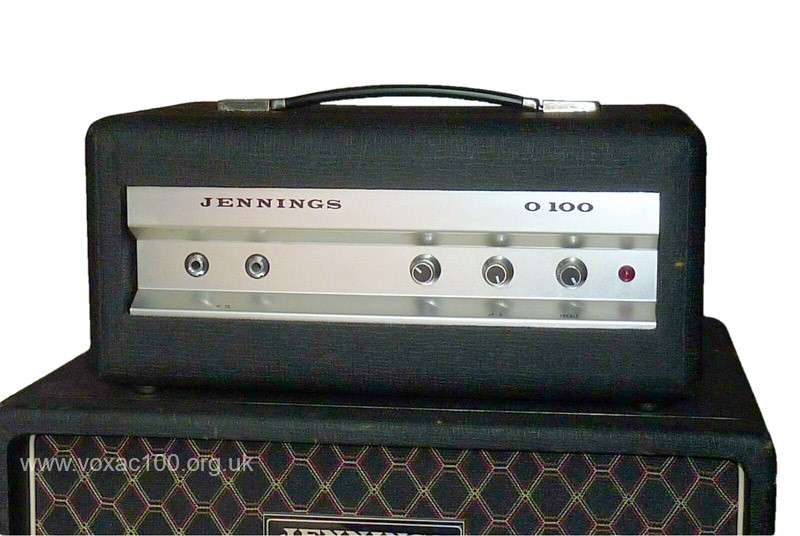
A Jennings O100 with a B3 cabinet.
Effectively much of the work of electronic and mechanical design work had therefore already been done. All that really remained was the re-jigging and re-voicing of the preamps - a single channel version for the O50 and O100 and another for the B50 and B100 - and the designing of a new wooden case. These last are likely to have been made either by Henry Glass (Hainault) or Heathpoint Timber (Rayleigh).
The PA amps measure 15 1/2 x 8 x 11 inches, the "O" and "B" series amps 17 x 9 x 7 1/2 inches.
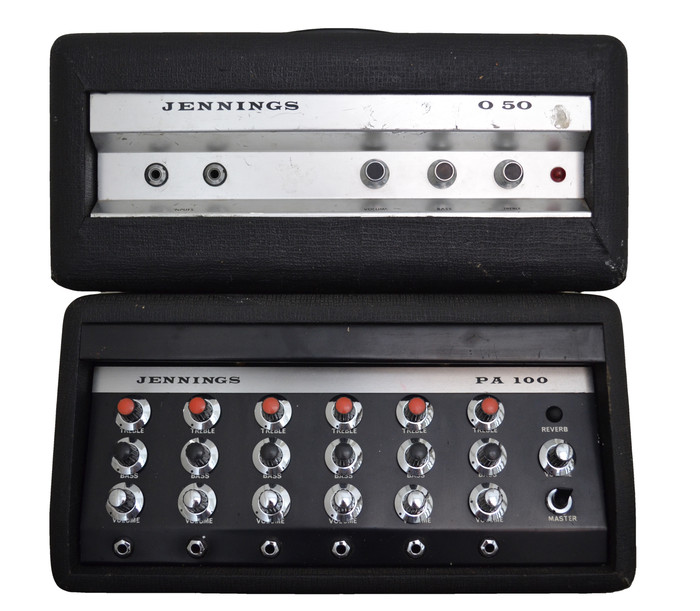
A Jennings O50 and a PA100.
Assembly of the chassis was contracted out to Triumph Electronics in Purley, which had done a good deal of work for Tom in JMI days. Indeed, Triumph may even have played a part in the design of PA amps shown by JMI at the Russell Hotel in late 1967.
At any rate, the rear panels of Tom's "O" and "B" series amps are identical to Triumph's own "Silicon" range.

Geoff Johnson, owner of Triumph Electronics, demonstrating Triumph's strap with built-in preamp at the Frankfurt Fair, February 1968. Rosetti was Triumph's distributors.

Triumph Silicon PA 100, front.

Triumph Silicon PA 100, rear.
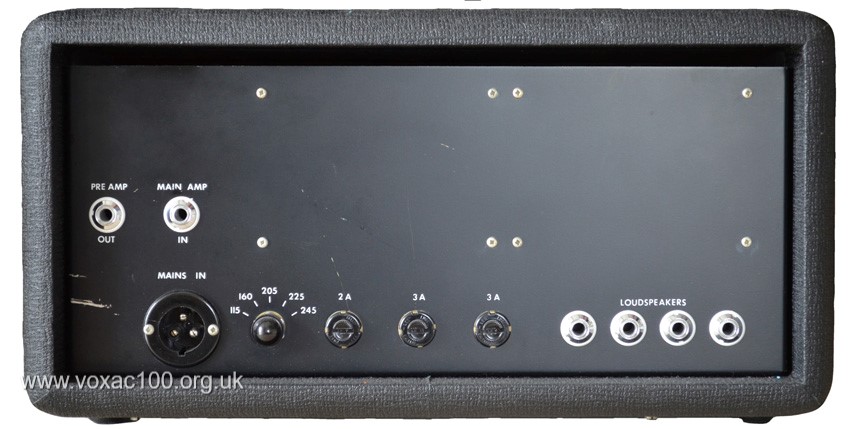
Rear panel of a Jennings PA100, last third of 1968. The power socket is a Bulgin.
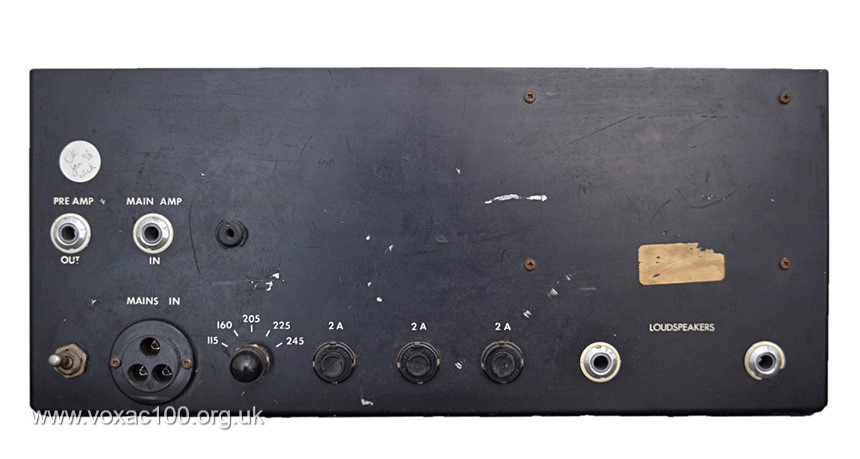
Rear panel of an 050, c. 1970. The power socket is a Belling Lee L1722, as used on solid state Vox amplifiers.
Note that the 100 watt amps across the range had four loudspeaker sockets. The 50 watt amps had two. Provided as standard, a preamp out socket, to feed into the power section of another amplifier, and the power amp in, to allow the signal from a different preamp to be amplified.
Further, more detailed material to follow on the electronics and the circuits of the "O" and "B" series amps. Just to say for the time being that transformers were sourced from Radiospares - one type with pairs of 27v secondaries, the other with 30v.
Transistors
Transistors were RCAs, doubtless sourced direct from the main UK warehouse/outlet in Surrey. The latest date codes encountered so far are from mid 1972 (this naturally may have to be adjusted up).
Power transistors
50 watt amps: a pair of RCA 2N2054s. Also most J40s and PA50s.
100 watt amps: a pair of RCA 2N2055s. Also most J100s and PA100s.
Driver boards
Common across the two series, also to the PA amps, the J40 and J100, and the J200 (a board each for the two discrete power sections), five transistors in total: RCA 40406, 40407, 40408, 1A04, and a 40594.
Preamps
Again, common across the two series: two BC109s.
Below, simply for orientation, a standard "O" and "B" series driver board. The group of three transistors near the lower edge of the board are in order (bottom to top): RCA 40406, 40407, 40408; the transistor top left with a star-shaped heat diffuser is the 1A04; and at right the 40594.
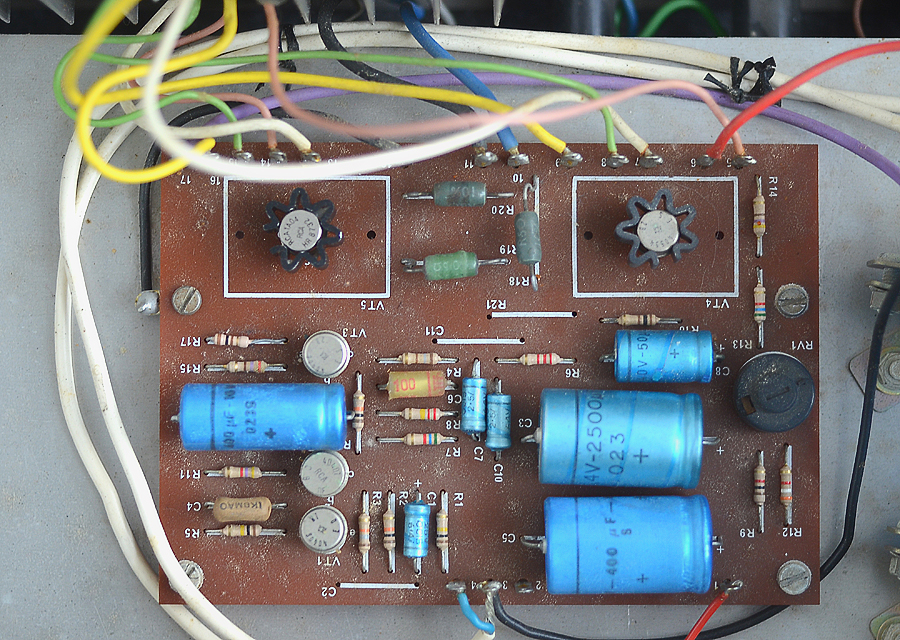
The rather dusty driver board of a JEI O50.