

VOX AC100 - UPDATES AND NEW INFO
January to March 2023
31st March
A general view of the back panel of the first generation MC100/6. The dimensions of the amp are exactly the same as later MC100/6s - 19 3/4" wide; 9 1/2" tall; and 11 1/2" deep. The preamp and power sections are arranged on separate sub-assemblies.
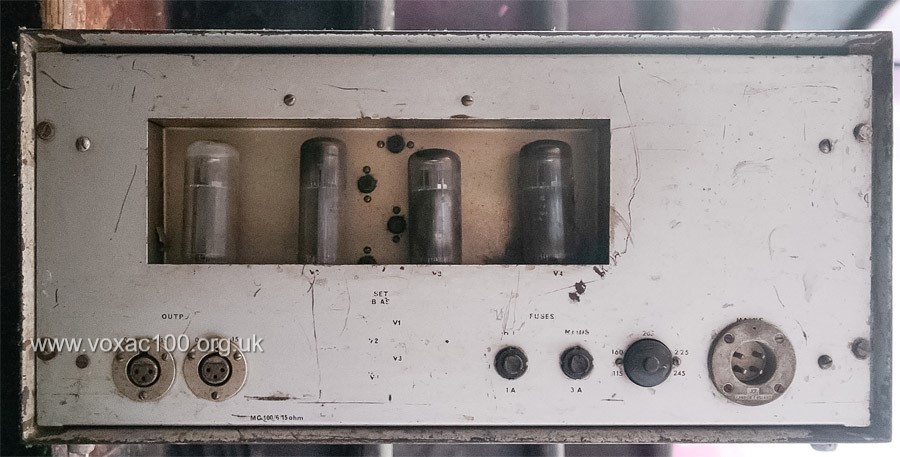
Note the arrangement of the bias pots, aligned vertically and staggered left and right.
30th March
A detail of the back panel of a first generation Metal-clad MC100/6 public address amp, one of a set of four supplied by JMI to a TV company in late 1964 / early 1965. The Belling terminal block - see the entry below for 21st January - was replaced by two Cannon XLR-3-13 sockets early on - so too the Bulgin mains socket (by a large Cannon four-pin XLR-4-13). More to follow soon.
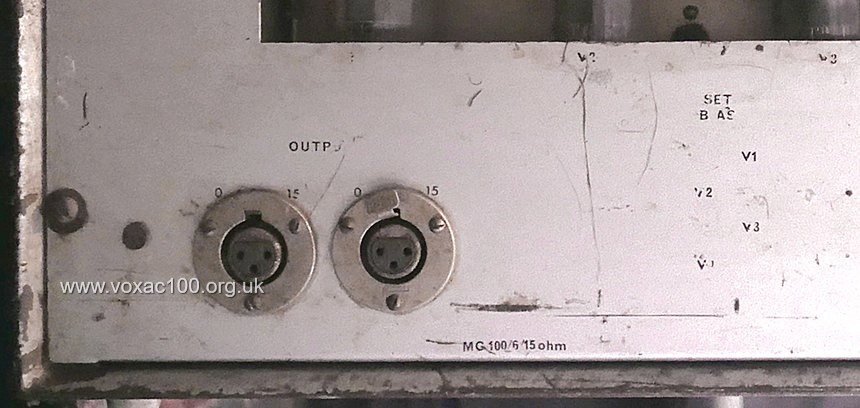
Legends, as ever, are Letraset. Note "MC100/6 15 ohms" along the lower edge. In the centre: "SET BIAS", with the valve numbers one below the other, reflecting the arrangement of the adjustment pots in the recessed valve compartment.
14th March
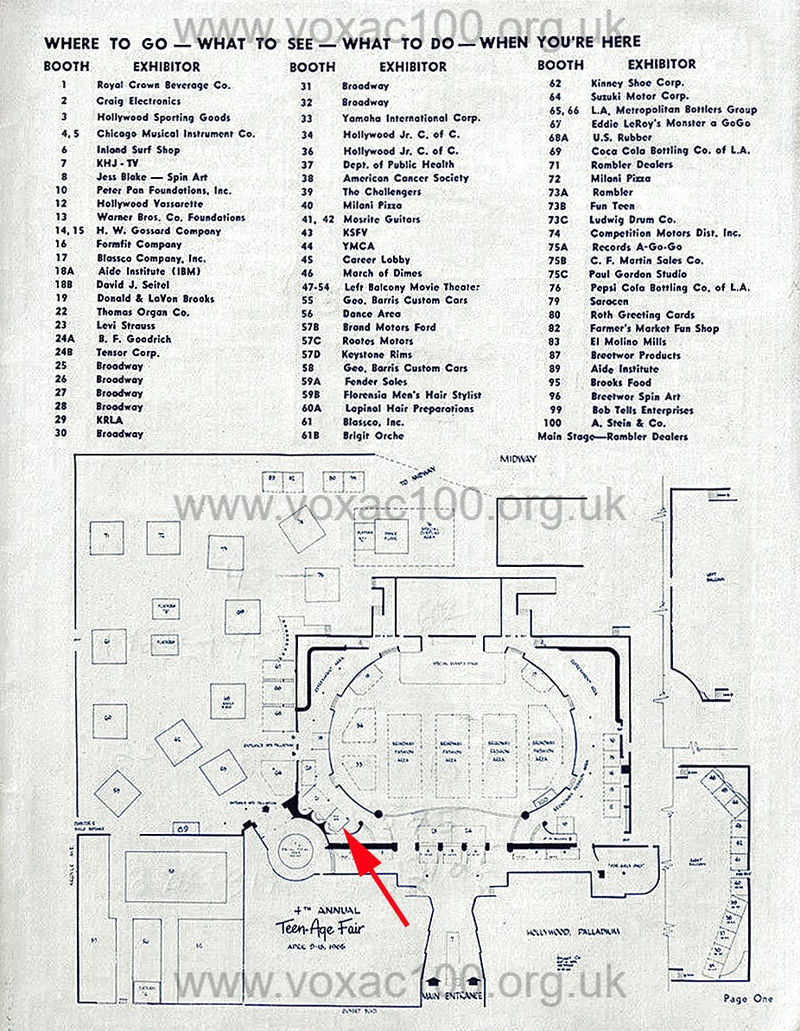
Below, a page from the published calendar of events at the 4th Teen-age Fair, Hollywood Palladium, April 1965. The Thomas Organ Vox stand is marked with an arrow. In terms of musical instrument manufacturers, also present were The Chicago Musical Instrument Company, Mosrite Guitars, Yamaha, Fender, Ludwig Drums. and the C.F. Martin Company. George Barris Custom Cars also had a stand. Barris later went on to produce the "Voxmobile" for Thomas Organ.

Marvin Kaiser, head of Thomas Vos sales, at the Fair. His (published) view on selling guitars can be found here.
4th March
In the Spring of 1961, JMI introduced a number of new lines of Public Address equipment, offering Reslo, Elpiko and Grampian microphones in its catalogue, along with free-standing loudspeaker units (similar in design to those devised by hi-fi companies in the late 1950s).
All were aimed squarely at "beat" groups. JMI's work in the PA field up to this point had mostly revolved around the installation of sound systems - primarily for organs - in churches and community halls. Microphone systems were sometimes supplied too, though less frequently.
Behind the scenes in early 1961, the development of the Vox Radio Mic. was well underway, but the unit was not ready for demonstration/trialling until early 1962.


The loudspeakers were also advertised in Spring 1961 in the music trade press - in a "portmanteau" advert illustrating a spread of JMI's activities.

In general styling, the units were not too far removed from the speakers provided by JMI to accompany organs. A wood veneer finish was also offered in 1964 for JMI's small wall-mount 8" and 10" cabinets.
In terms of sound dispersion, the new floor-standing loudspeakers were "directional", containing a single driver at top and possibly a second in the body of the column. Resonant damping in such cabinets was normally achieved in the late 1950s and early 1960s either by a network of shaped horns and pipes, or more simply, by acoustic foam.
Perhaps the most popular design in the hi-fi community, which is where free-standing columns were first adopted, was the "omni-directional" - as for example in the model marketed by Wharfedale in the late 1950s. Sound radiated from all four grilles at top.

Other companies - "Express" being one - took a different approach, producing directional units designed to throw the sound forward either into a room or at a wall which would then radiate it out. Design number 6 is similar to the one used by JMI.

So far, no surviving example of the JMI loudspeaker has come to light. Sales, however, are unlikely to have been substantial. The "Line Source" cabinets, designed in late 1962, proved far more popular.
3rd March
Herbert, the owner of the two Jennings Tympanos illustrated on this page, kindly provided some fascinating insights:
"I bought them in Germany in 1972/1975 (Hanover and Cologne). They were labeled as "Jennings Electronic Tympani" and "Jennings Electronic Conga", respectively. The famous JENNINGS branding and its futuristic design caught my attention at once. This had to be something special. But even the guys in the music shop were not really aware of its function. After having plugged it into an amp, I was hooked by the sound and the versatility of its handling. I can assure you that these instruments are definitely "terrific" as stated in the ad."
"You can play the tympanos with sticks or mallets, but I prefer playing them by hand. When I tap/hit the surface (resonant body), I notice a slight 'free swinging' of the box. This must be due to the hollow L-shaped tube stand. I assume that this swinging prolongs the duration of the resonance time, thus adding a kind of "sustain" to the tone."
"Its measurements are correctly shown on the photo:"
Height: 35/20/30 cm (from left to right)
Depth measured on front: 30 cm
Width: 70 cm (see attached HiRes photo with reference measure)
Weight of tympano: 7 kg
Weight of stand: 3 kg
Cable: Rigidly attached with a length of 2.30 m and a 6.3 mm jack plug
"The stand has a black coat (not chromium) and does not adjust to separate heights."
2nd March
Thanks to Herbert, some new info coming on the Jennings Tympano T.I, produced from early 1969 to 1972, the pair illustrated in the second half of the page currently in his collection.
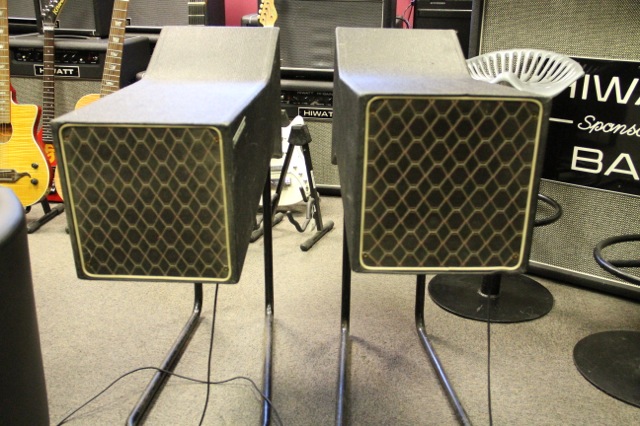
Jennings Tympanos are scarce these days. A pair survives in North America (pictured below), and there is at least one in the UK (possibly a pair). But that is more or less it in terms of examples that have surfaced over the last dozen or so years.
27th February
Copied over from the Vox AC30 website, an extract from a local Dartford newspaper on the fire at the Vox Works in Erith on the 1st December, 1965. Some of the amps destroyed were evidently AC100s that had been loaned to the Beatles for their autumn tour, the highlight being the Shea Stadium concert (caught on film).

"Employees ran for their lives as fire spread rapidly through the building. Within minutes the factor[y], working flat out on export orders to 64 countries, was a mass of flames. Kent and London Fire Brigades attended."
"Forty thousand guitars, organs, musical equipment, and amplifiers, including those used by the "Beatles" on their last trip to America were lost in the fire. Thousands of pounds worth of equipment awaiting transportation for overseas markets went up in smoke."
EMERGENCY SCHEME
"But within hours the Company was running an emergency production scheme. Said Managing Director Mr Tom Jennings: "In spite of this disaster we shall be able to meet all our orders"."
"Jennings Sales Director Mr Reg Clark commented: "The factory literally blew up. It went up like a bomb"."
"Oil storage tanks for central heating were situated on the top floor of the building where the explosion occurred. The "Reporter" understands that total damage caused by the blaze could reach £1,000,000."
24th February
A few days after the trade fair at the Russell Hotel in late August 1964, Tom Jennings and Eric Summer, chairman of Royston Industries, the company that owned a controlling share in JMI, applied to Companies House to form "Vox Sound Equipment Limited". VSEL was duly incorporated on 11th September (entry below from the digest Companies House register).
The principal reason for the creation of the new company: to provide a new vehicle for Jennings/Vox sales that was unconnected with the deal that JMI had just finalised with Thomas Organ in the USA. More on this to follow.

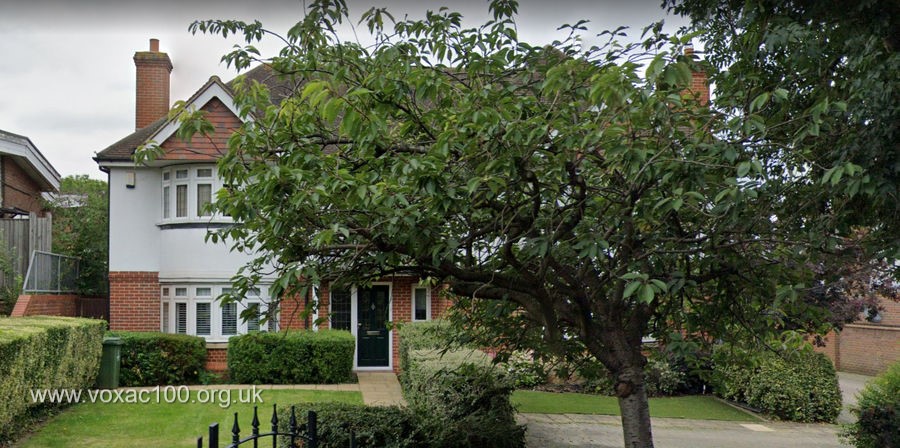
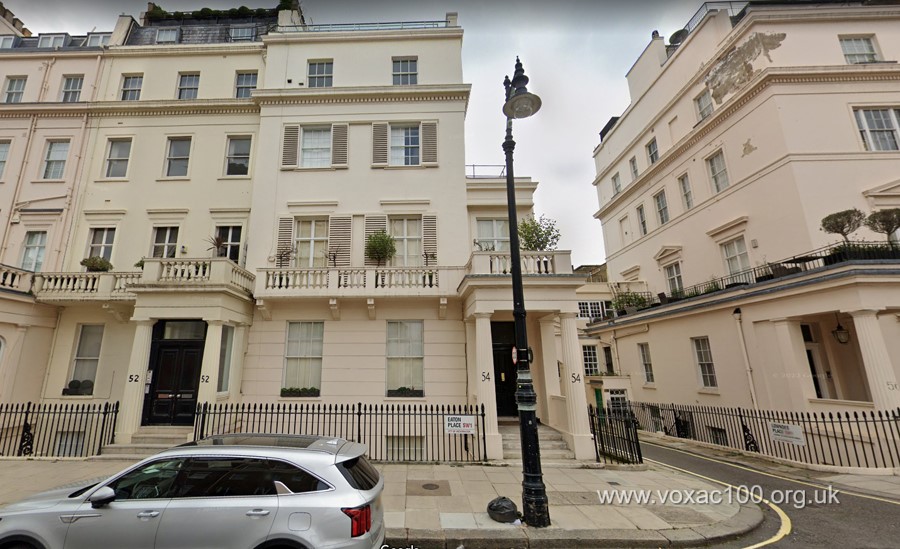
Below, shots from Google Street of Tom Jennings's house in Bexleyheath (half obscured by the tree); and Eric Summer's place in Belgravia (no. 54, end of terrace).
12th February
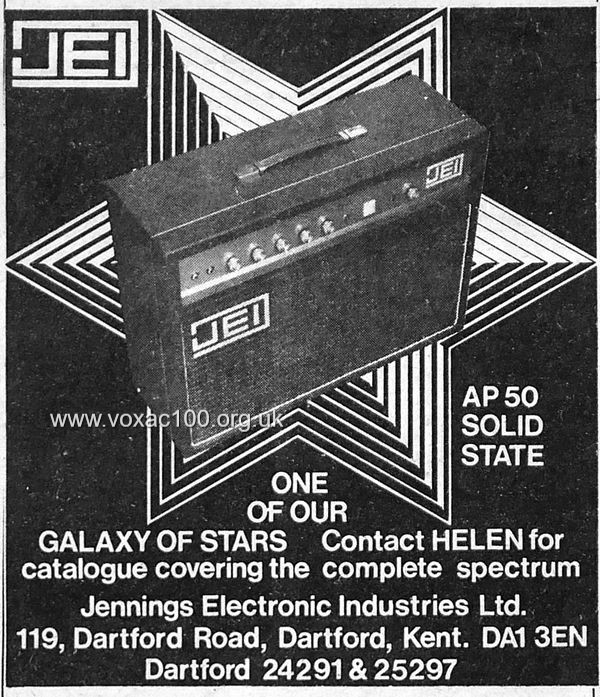
One of the last adverts placed by JEI in the popular music press, running from early July to late November 1974 every two weeks or so. Tom Jennings had probably left JEI, however, by the time of its first appearance. Whether Helen was Tom's daughter is not known. It is possible that the run of ads had been paid for well in advance.
July to November 1974
8th February
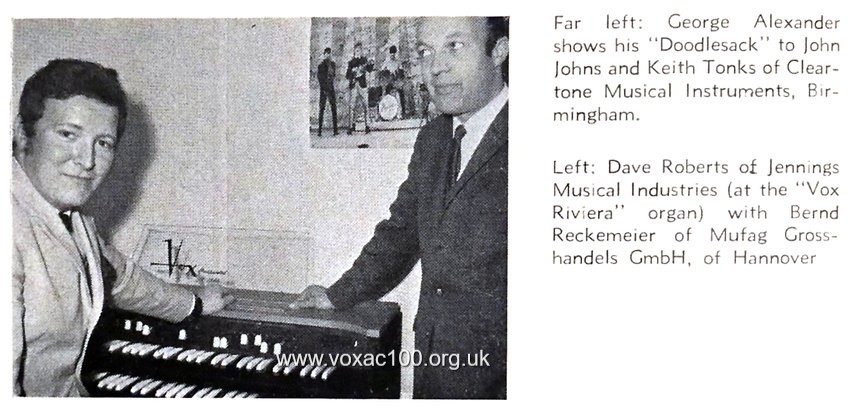
Dave Roberts of JMI demonstrating the Vox Riviera organ at the Frankfurt Trade Fair, March 1968. The Riviera, in prototype form, had been displayed at the Fair the year before.
Mufag was the oldest and most important of the three distributors of Vox equipment in Western Germany, having been signed up by Tom in 1965.
March 1968
7th February
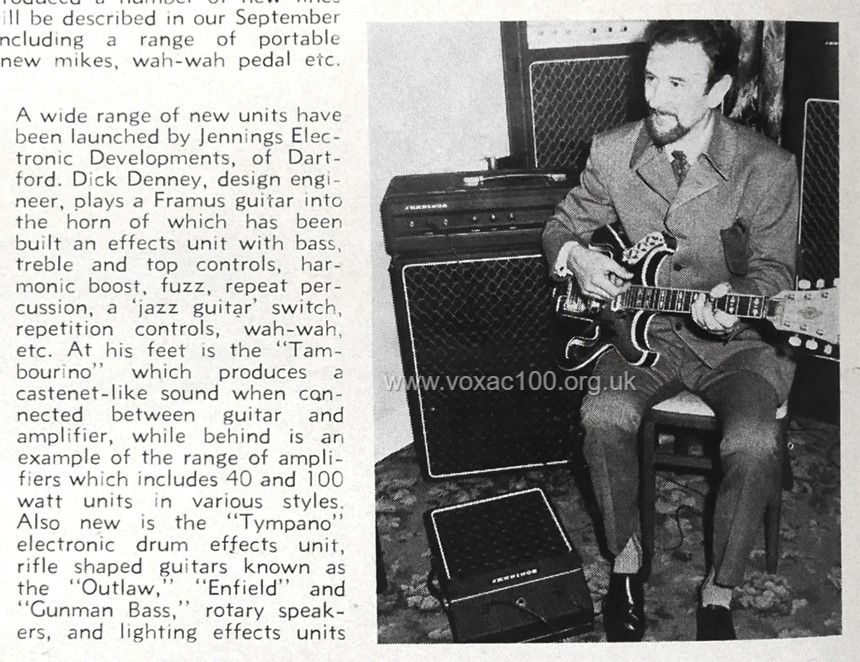
A great shot of Dick Denney representing Tom's new company - Jennings Electronic Developments - at the Russell Hotel Trade Fair, late August 1968. In view, early versions of the J100 in two forms: separate amplifier section on top of a D4 (?) speaker cab, and a J100 combo partly out of picture at top.
A photo taken from a different angle can be seen a little way down this page. The page on the J100 amplifier is here.
September 1968
6th February
Below, a fairly uncommon survival - the warning note on the baffle of the speaker compartment of a JEI J40 amplifier. D4 speaker cabinets and the J100D combo amplifier had a version of this note referencing the J100 amplifier and a total impedance of 4 rather than 8 ohms.

Also just to note that further material has been added to the new overview page on the JEI "O" and "B" series amps.
5th February
The page on the design (in overview) of the JEI "O" and "B" series amplifiers is now up. Some expansion will be necessary in due course as the "O" and "B" series amps have much in common with the JEI J40, J100 and J200.
Original circuit diagrams (schematics) for the JEI solid state amps have so far not come to light - possibly because they were ditched when the company closed its doors in 1975. It may be, however, that copies are "out there" somewhere.
In July 1969 it was reported that Tom had set up agencies in London, Cardiff and Manchester, each of these entities doubtless having its own documentation, perhaps mainly sales-orientated, but just possibily technical sheets too - one never knows.
4th February
Further additions and updates to the sections on Tom's post-JMI companies, "Jennings Electronic Developments" (1968-1969) and "Jennings Electronic Industries" (1968-1975).
New pages have been started on the JEI Tape Echo; the JEI J67 single manual organ (a "holding" page for the time being); the JEI J72 console organ; the D4 4x12" speaker cabinet; and the Jennings columns with rotating speakers.
The existing page on the Jennings RT.10 has been updated.
In progress, introductory pages on the JEI organ range as a whole; and the solid state "O" and "B" series amplifiers.
2nd February
Some updates on Jennings organs / keyboards. It seems likely that the K1 percussion keyboard, promoted only once in 1969, was in fact a sort of "tester" to gauge market interest. Its form: probably little more than a stand-alone version of the third manual of the J71 organ.
Added to the page on the Jennings J68 and J69 organs, an overview of the footings and voicings. More to come on those in due course. Also to note that the drawbars of the J68 are of the type that Tom successfully moved to protect in law - via the old Patent Office - in April 1971.
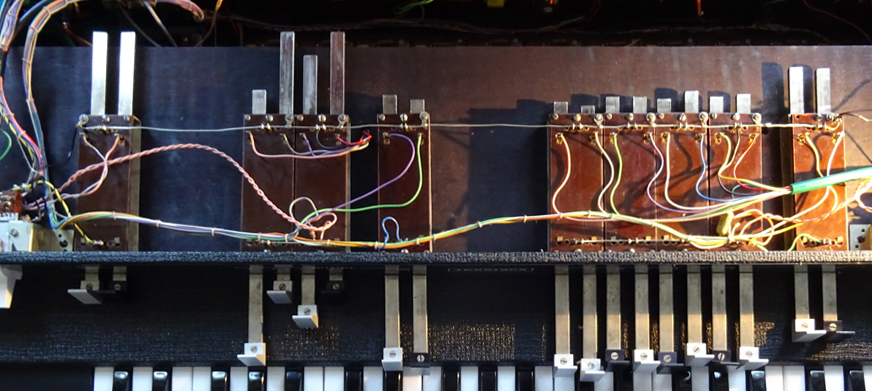
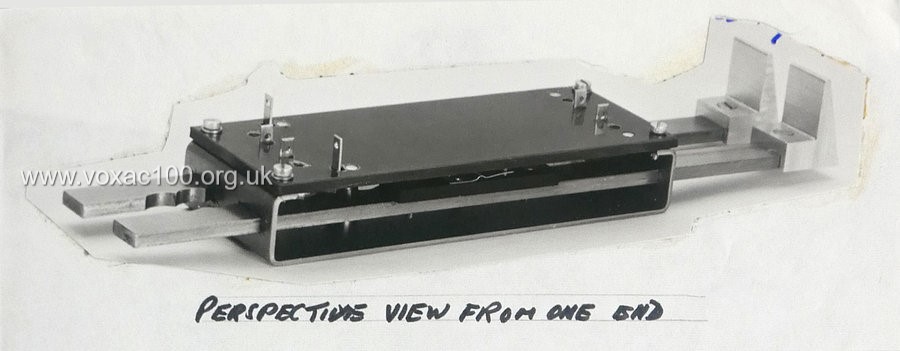
Detail from Tom's photo submission, April 1971.
1st February (2)
A correction to the entry for 31st January: the "Jennings Scene" brochure is from early 1969 - NOT 1968. It was drawn up to accompany the Jennings display at the Frankfurt Fair.
1st February
Three new pages on things JEI have been kicked off: - on the B50 bass amplifier; the J68 and J69 organs of 1969; and the K1 percussion keyboard. Links can be found on the second of the two JEI index pages.
31st January
Pages have now been started on the Jennings Electronic Industries line source public address speaker cabinets - the LS410 (4 x 10") and the LS412 (4 x 12"), 1968-1973, rivals to the Vox Line Source 40 and 60.

Detail from Derek Underdown's copy of the Jennings Electronic Developments brochure of early 1969 - not 1968 - certainly in existence by the time of the Frankfurt Trade Fair. Thanks to Toni Standing, Derek's daughter.
30th January
Thanks to Tony, a shot of a JEI Echo unit. These were produced in very small numbers, 1974-1975. More on the Echo to come soon.

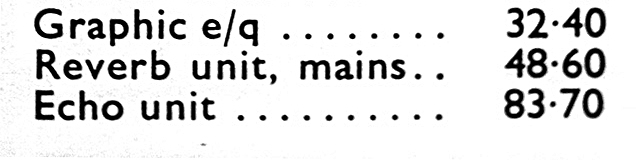
Detail from an overview of JEI prices, December 1974.
29th January
A new page on the Vox microphone mixer units supplied to and sold by Thomas Organ has been started here. More to come (in the shape of augmentations to the page) shortly.
Below, a detail of the illustration in the Thomas "King of the Beat" catalogue, late autumn 1965:

Detail, "King of the Beat" catalogue, late autumn 1965. The Mark 2 mixer (M.2). Six channels, high gain inputs at left, then three low gain. At right overall Bass and Treble controls. The front of the cabinet, with its storage compartment, could be completely removed.
28th January
A little more on JMI's public address equipment pricelist - see below the two entries for 29th December. One obvious thing that should have been stressed is that the amplifiers in view required a 12vdc supply. They were primarily (operative word) intended for use in mobile applications - cars, vans, boats, and so on. JMI provided an inverter supply to power them from the mains.

The manufacturer from which Eagle Products originally sourced the units offered by Jennings (and others) is likely to have been TOA. TOA also made the megaphone on the Jennings list.
Although early TOA amplifiers are extremely thin on the ground these days, it should be possible in time to track down at least one surviving example. A hand-drawn circuit diagram was made in recent years from an amp described as being a TOA CA712, the model number corresponding with the one at the head of JMI's pricelist.
23rd January (3)
A slip corrected on the new page on the MC15 - the rectifier valve is an EZ81 NOT an EZ80.
23rd January (2)
A new page on the Vox MC15 public address amplifier has now been added, pictures of a surviving example thanks to Oly.
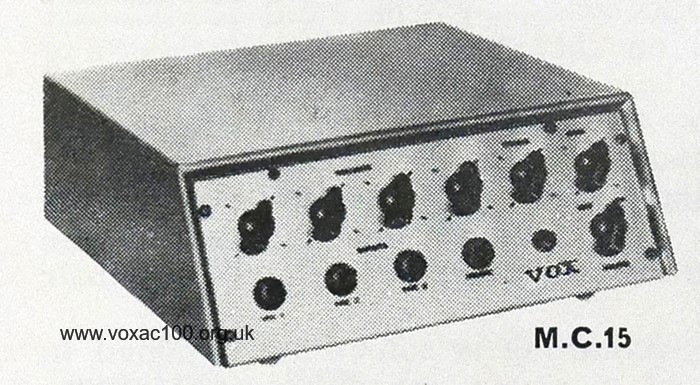
Detail from a JMI advert published in the music trade press, December 1964.
Some of the existing pages on the Metal Clad range will naturally now need adjusting slightly - changes will be signalled here as they are made.
23rd January
Just to note the presence of AC100 serial number 389 on Reverb.com (it's been there for a while now). Condition is good - transformers and choke in place with the familiar date codes January and February 1965, and the preamp largely in original order. The cathode bias network in the power section has been redone.
The amp is likely to have been produced in the late spring of 1965 and exported directly to the USA with its speaker cabinet - either a 2 x 15" bass, or perhaps more likely, an SDL 4 x 12". The cab belonging to serial number 392 has speakers dated May 1965.
For all the talk of "overheating" - yes they do get hot (which is not quite the same thing) - these amps are well made and long lived. Very few have lost their original transformers.
21st January
A final note - for the time being at any rate - on Vox public address amplifier speaker connectors. Below, two Belling L1469 blocks installed (as from factory) on the rear panel of an MC100 from the second half of 1965.
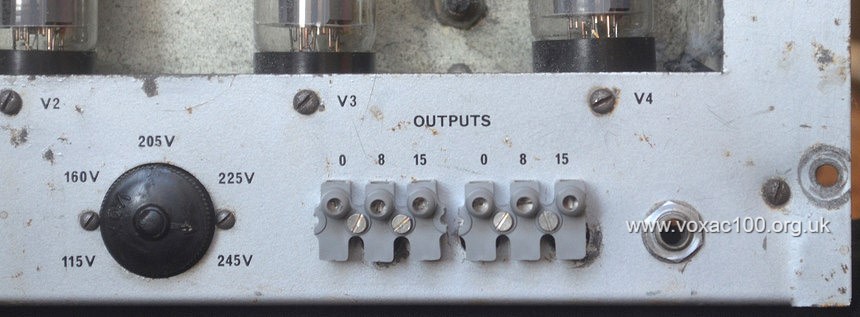
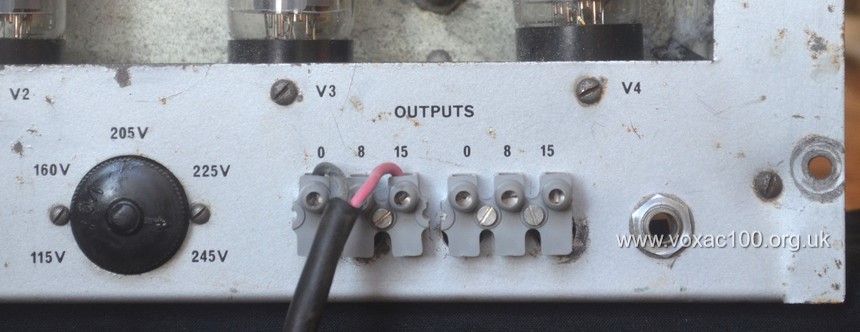
Such blocks were standard on the Metal Clad range from 1964 through to the end of 1965. MC15s, MC30s, and MC50s had one, MC100s two. Anyone wanting to run a pair of Line Source column speakers from an MC15, MC30, or MC50 would simply feed the two sets of wires into the common and 8 ohm socket, the two speakers (15/16 ohms apiece) standing in parallel in relation to the amp, so presenting a total impedance of 8 ohms.
This is exactly what was done when AC30 Super Twin amplifier sections were used as PA amps - two speakers connected together into the terminal block.
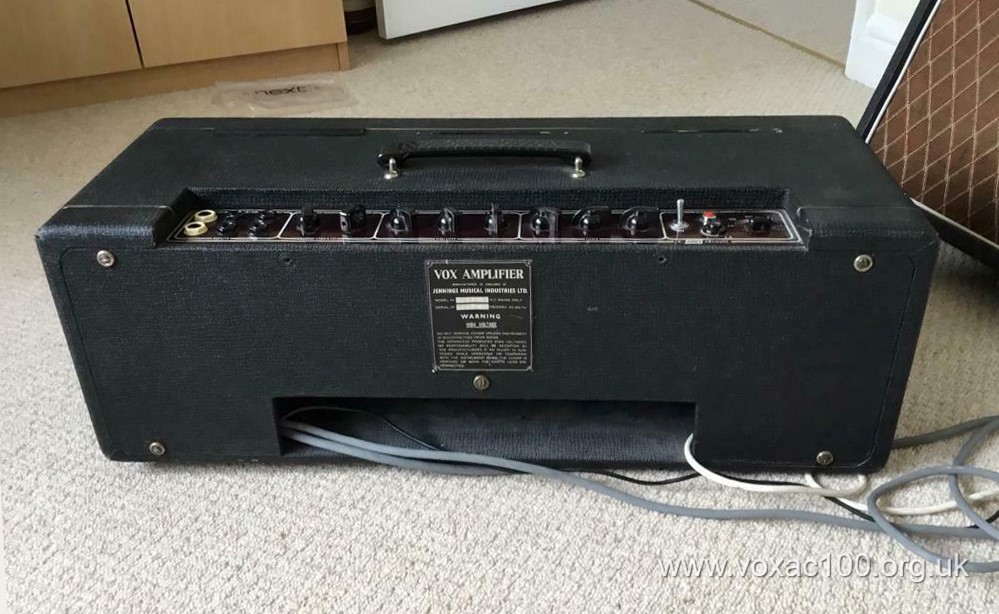
An AC30 Super Twin amplifier section issued by JMI as a public address amp in conjunction with two Line Source 40 column speakers. The grey speaker cables feed into the amp at left. Numerous AC30 PA sets of this type were sold (and resold in the 1970s - see the small ads in "Melody Maker" magazine).
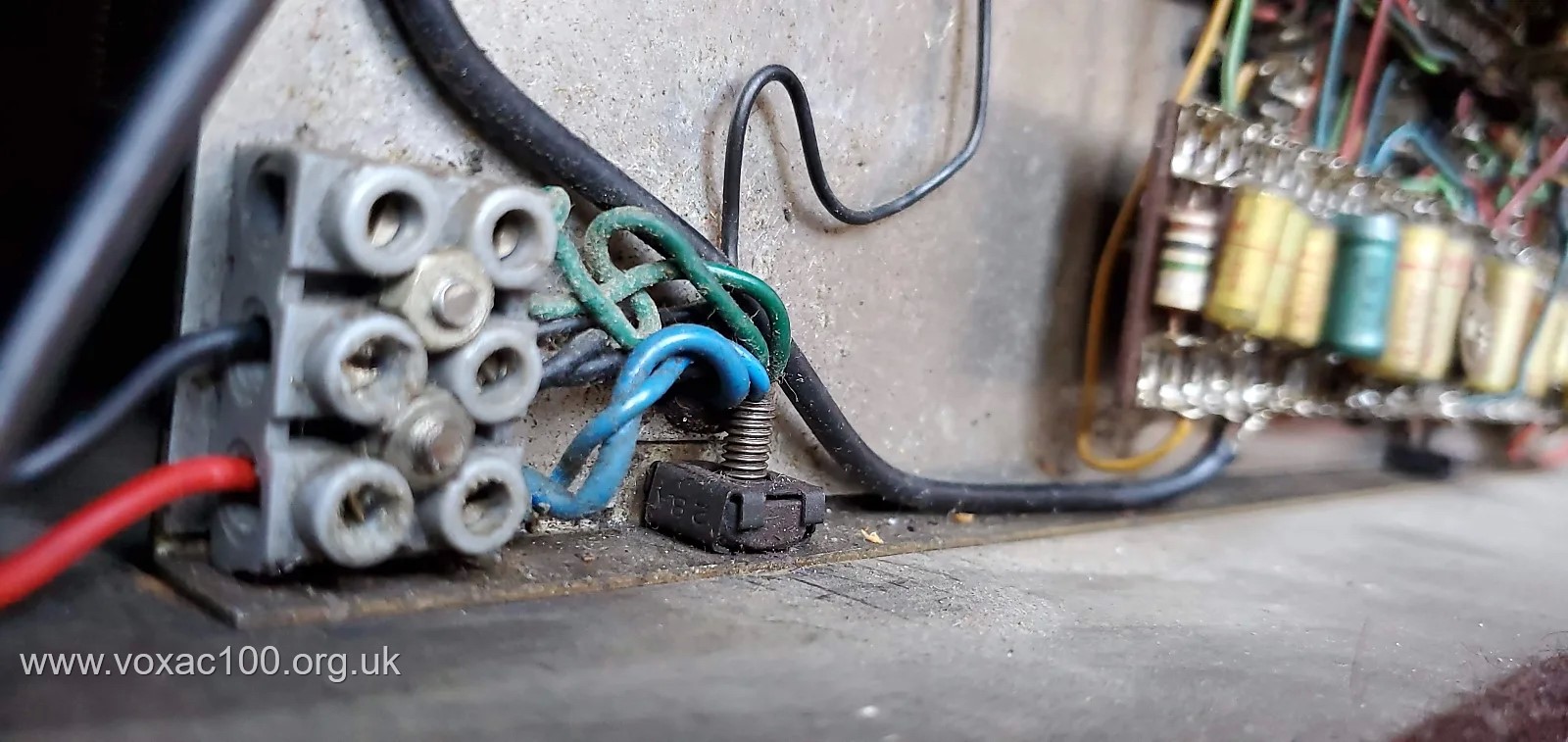
A detail of an AC30 speaker terminal block (also made by Belling Lee).
20th January
Well, the search is over. Thanks to Belinda, a Belling Lee L1469 terminal strip, which arrived in its original waxed paper package.
JMI separated these strips into blocks of three for its PA amps. The rubber is such that it can be cut with a sharp knife or scalpel. They were fixed to the chassis with 5BA cheese head screws, 5/8" long.
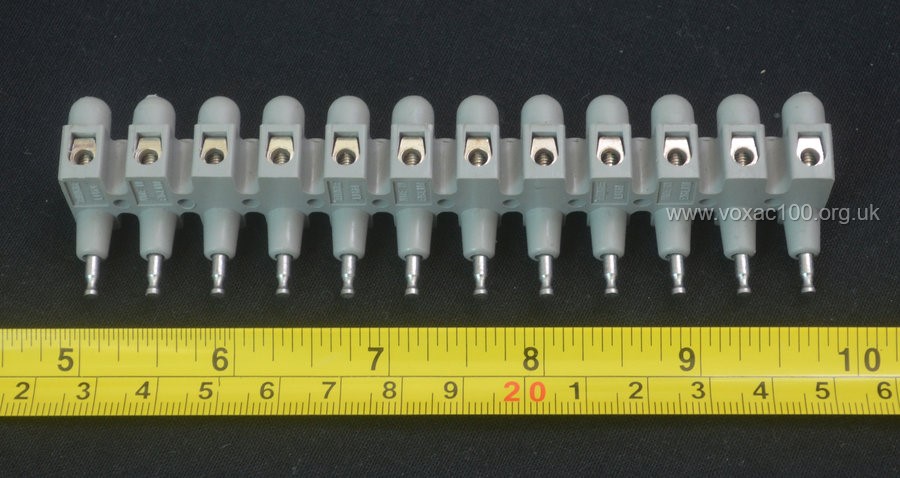


The patent asserted on the ends of the strips applies generally to Belling Lee's terminal blocks, not specifically to the L1469.
13th January
Yesterday's entry has been adjusted, the Belling blocks are part number L1469 - the L1409s are one size too small.
>12th January
More on the speaker connectors fitted to early Vox Metal Clad public address amplifiers. Thanks to Oly, a detail of the rear panel of an MC15 from mid 1964. The connector in view is a Belling Lee L1469 (not L1409) pass-through terminal block.

Detail of the Belling L1409 speaker terminal block, Vox MC15 from mid 1964.
The bare wires of the cables from the speakers were secured in the the block (or blocks) with captive screws - much as in the terminal blocks attached to the chassis of AC30s, AC50s, AC100s and so on.
Belling L1469s are scarce these days. Even in the 1960s such connectors are not likely to have been common - perhaps only obtainable direct from Belling. Below, a couple of shots of a strip (of 12) from the 1970s/1980s, slightly different in minor details from 1960s production, but in all important dimensions the same.
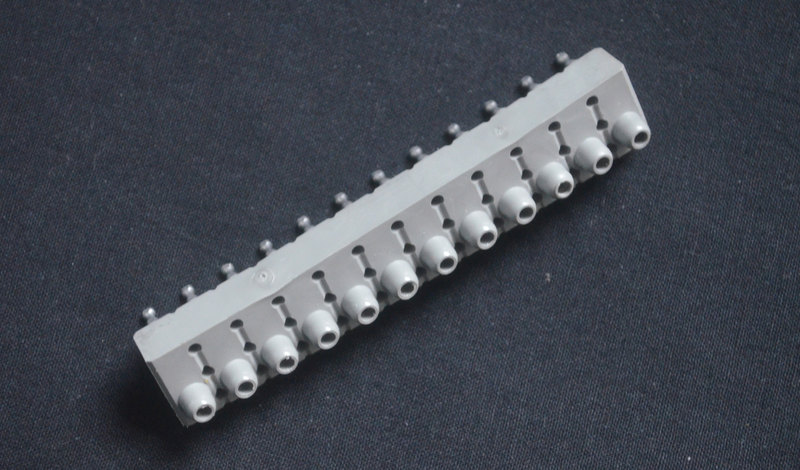
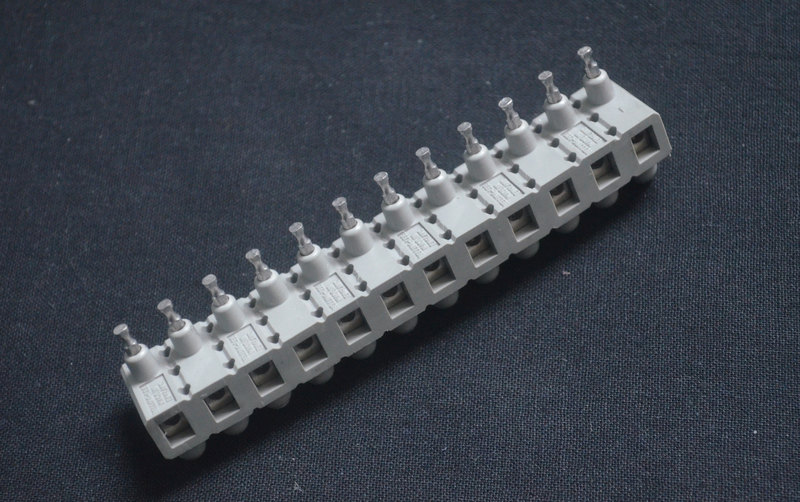
These are L1409s, the same format, but one size smaller than the ones JMI/Triumph used.
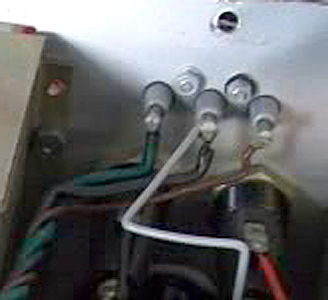
A detail of the solder terminals of the L1469 terminal block on an early Vox MC50 amplifier.
Triumph Electronics, which made the early Metal Clads under contract for JMI, provided the necessary 1/4" holes and fixing points on the back panels of the amps, and applied the L1469s in blocks of three.
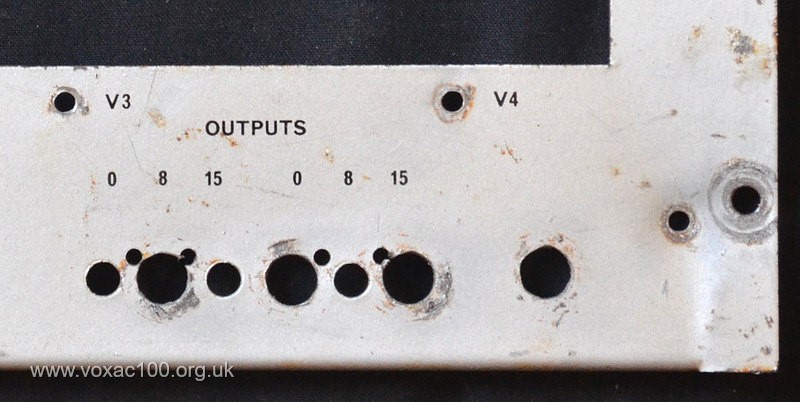
The rear panel of MC100, three of the holes later widened to take 1/4" jack sockets.
As has already been noted, the 1/4" holes were also capable of being fitted out with Belling L1737 sockets (to receive cables fitted with 1/16" plugs) - see this page, which will now need to be updated. A second early MC100 has holes only for one set of L1737 sockets.
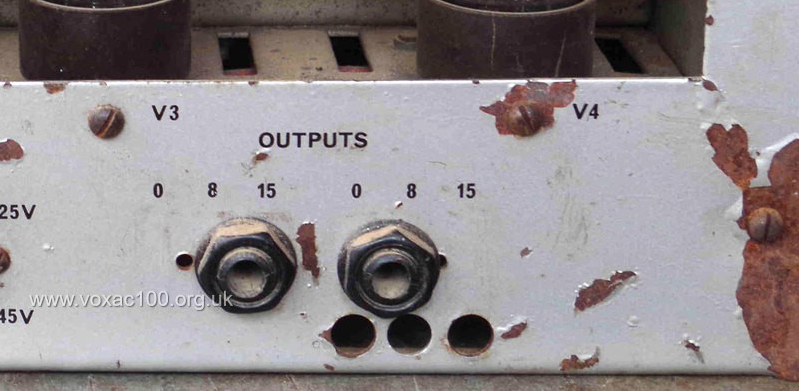
If anyone knows of other manufacturers that used Belling L1409s or L1469s - in any type of application - do let me know.
10th January
A new page has been started on JMI's trip to Scarborough in August 1964, principally to bring together material that is otherwise slightly dispersed on the site.
9th January
Picking up from the entry below (4th Jan.), some pieces on the Beatles' concerts in Scarborough, Sunday 9th August, 1964, from local newspapers.
The comment in the third piece - that new 100 watt sound cabinets and amplifiers were brought up for the shows - is of great interest. The speaker cabinets were certainly new. The amplifiers? Perhaps simply the ones that JMI had issued to John and George for use in Stockholm in late July. At any rate, they evidently all came up in the JMI van with Eddie Haynes et al.

Advert placed in the papers on the days before the two shows (early and later evening). The Beatles appeared as part of a Kennedy Street Enterprises package (not part of the Arthur Haynes programme as previously stated).

The crowd outside the Futurist Theatre, Sunday afternoon.

.
6th January
Thanks to Oly, a preliminary picture - others to be posted soon - of an extremely rare Vox MC15 Public Address amplifier from the third quarter of 1964 (in terms of assembly probably nearer the middle than the end). Its serial number, machine stamped, is 5594, part of the series used for AC15 combo amplifiers. MC50 and MC100 serial numbers by the same token took their place in the series used for the AC50 and AC100.

Serial number 5594
4th January
Thanks to Ed, a picture taken on 9th August, 1964, by Eddie Haynes (who worked with Reg Clark on JMI's promotions) on stage at the Futurist Theatre, Scarborough, shortly before the Beatles' first performance there (6.25pm). A small team from JMI led by Dick Denney had brought John and George's new AC100 SDL speaker cabinets up from Dartford earlier in the day, the amplifier sections having already been consigned (in late July).

9th August, 1964.