
Vox AC80/100 and AC100 plate resistors
AC100s "blowing up". Who knows where the myth started - probably with poor souls prone to exaggeration. "It just blew up mate, they ALL just blow up".
That said, a good number of early 100 watt amps did have a weak point - their plate resistors. Marshalls, as well as Vox, Fender, Selmer, and so on. Numbers of these resistors evidently flamed out. Where AC100s are concerned, one can often see the tell-tale scorch marks on the tagboard, everything else - transformers, bias and screen resistors - perfectly OK.
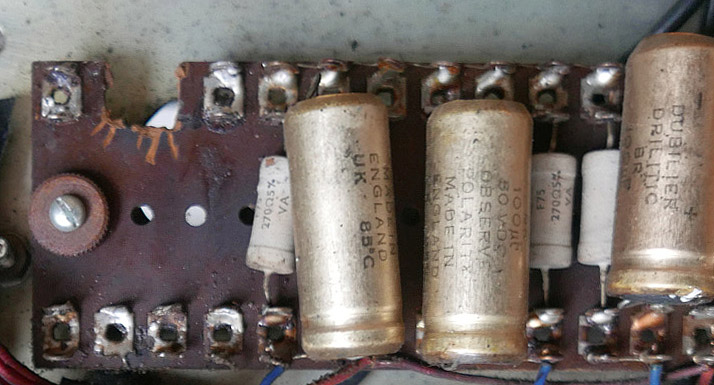
Detail of an early AC80/100, the plate resistors having flamed out at some point. The transformers, cathode bias network, and original EL34s (which still work, though obviously not "as new") were completely unaffected.
As for those plate resistors that did not flame out (the greater proportion of amps) diligent servicing in the 1970s and 1980s generally saw their removal.
Below, an overview of the types of resistor used by Westrex and Burndept, the two main contractors charged with assembling the chassis:
Copper and black panel cathode biased AC100s: assembled by Westrex. So far no amp has come to light with its original plate resistors in place. It seems likely that they were the 1/2 watt Dubiliers used by Westrex in the preamp.
Grey panel cathode biased AC100s: assembled by Burndept. Plate resistors were 1/2 watt Eries (as in the preamp). These can be seen in serial numbers 323, 392, 414, and a handful of others.
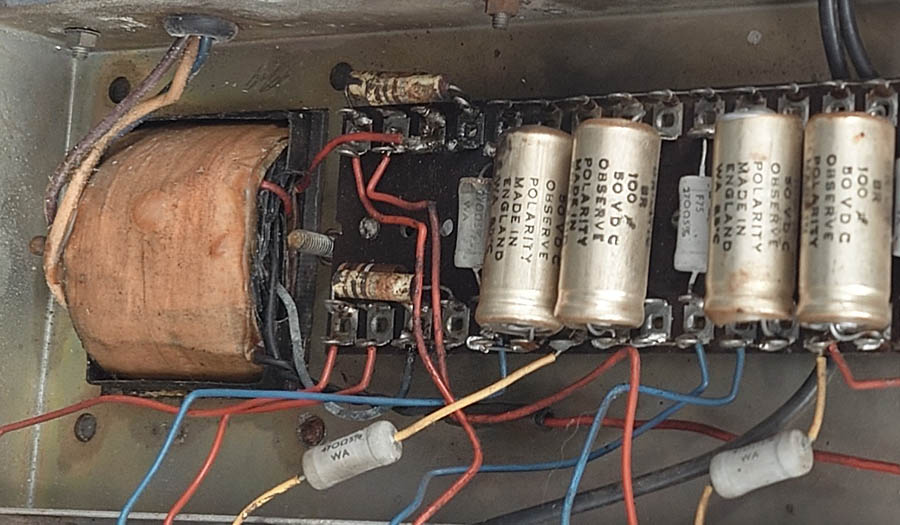
Serial number 414.
Grey panel fixed bias 100W Amplifiers: assembled by Burndept. Plate resistors changed to large 1 watt Eries. Plenty of examples can be seen in surviving "100W Amplifiers", JMI's first version fixed bias AC100.
Grey panel AC100 Mark 2s: assembled by Burndept. As above, large 1 watt Erie plate resistors.
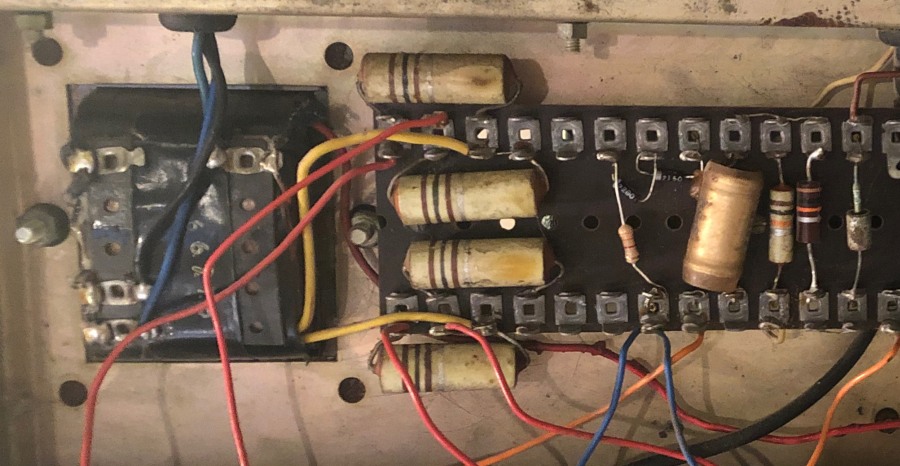
AC100 serial number 1657, second quarter of 1966, original Erie 100 ohm plate resistors. Thanks to Keith for the picture.
19th July
Further pictures of AC80/100 serial number 414 have now been added here. The amp retains two of its original plate resistors - an unusual thing. Repairmen in later decades were not slow to replace these in other AC100s.